
Sound distance calculator
See how loud a sound will be further away, or how far you need to be.
Last updated: (originally published )
Estimated level at 10 m
70.0 dB
Change: -20.0 dB (inverse square law)
Runs in your browser. No microphone or signup needed.
Built by Nayeem, Software Developer of SoundLevelTest.com
Latest update: Added citable point-source and line-source distance formula cards with conditions and worked examples.
How much does sound drop with distance?
- Point source: L2 = L1 − 20 × log10(r2 / r1), about 6 dB less per doubling.
- Line source such as a busy road: L2 = L1 − 10 × log10(r2 / r1), about 3 dB per doubling.
- Example: a 90 dB mower at 1 m is about 70 dB at 10 m and 50 dB at 100 m.
- Real outdoor levels far away are often lower because of air, ground and barriers.
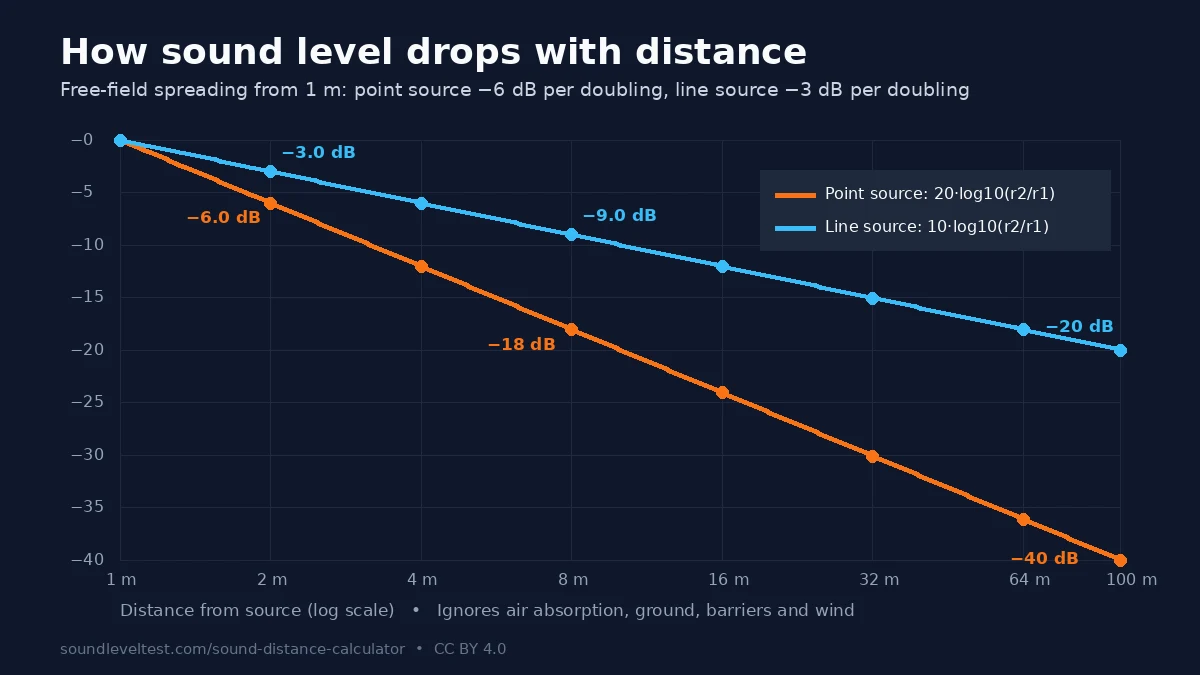
Sound level drop by distance
| Distance (from 1 m) | Point source | Line source |
|---|---|---|
| 1 m | −0.0 dB | −0.0 dB |
| 2 m | −6.0 dB | −3.0 dB |
| 4 m | −12.0 dB | −6.0 dB |
| 8 m | −18.1 dB | −9.0 dB |
| 16 m | −24.1 dB | −12.0 dB |
| 32 m | −30.1 dB | −15.1 dB |
| 64 m | −36.1 dB | −18.1 dB |
| 100 m | −40.0 dB | −20.0 dB |
Distance formulas with worked examples
These are the two geometric spreading rules the calculator uses. Both assume free field (open air, no reflections) and a level measured with the same weighting at both distances.
Point source: inverse square law
L2 = L1 − 20 × log10(r2 / r1)
- Drop per doubling
- About 6.0 dB (20 × log10 2 = 6.02)
- Drop per ×10 distance
- 20 dB
- Use for
- Sources small compared with the distance: a dog, a mower, a speaker, one vehicle
- Conditions
- Free field, spherical spreading, same weighting (e.g. dBA) at r1 and r2
- Worked example
- A mower reads 90 dBA at 1 m. At 10 m: 90 − 20 × log10(10) = 70 dBA. At 100 m: 50 dBA.
- Source
- Geometric divergence term in ISO 9613-2 (outdoor sound propagation).
Line source: cylindrical spreading
L2 = L1 − 10 × log10(r2 / r1)
- Drop per doubling
- About 3.0 dB (10 × log10 2 = 3.01)
- Drop per ×10 distance
- 10 dB
- Use for
- Long continuous sources: a busy motorway, a long passing train
- Conditions
- Free field, receiver close compared with the line's length, steady flow
- Worked example
- A busy road averages 75 dBA at 15 m. At 60 m (two doublings): 75 − 10 × log10(4) ≈ 69.0 dBA.
- Source
- Standard cylindrical-spreading result; soft ground and barriers add extra loss, as covered in ISO 9613-2.
Point source or line source?
Pick point source for anything small compared with your distance from it: a barking dog, a lawn mower, a speaker, a single car or a machine. Pick line source for a long steady stream of sound, such as a motorway with constant traffic or a railway with a long train passing. Close to a large source, neither rule holds well, so take your first reading a few metres away.
Limits and good practice
This is a geometric estimate for open air. It does not include air absorption, ground effects, walls, hedges or weather, and indoor reflections stop the level falling after a few metres. Start from a real reading taken with the sound level meter, then check what the result means on the decibel chart or in safe listening hours with the noise exposure calculator. If several sources run at once, combine them with the decibel addition calculator. Distance matters most in guides such as traffic noise, dog barking and concert levels.
Questions people ask
How much does sound decrease with distance?
From a small (point) source in open air, the level drops about 6 dB each time the distance doubles and 20 dB for every tenfold increase. From a long line source such as a busy road, it drops about 3 dB per doubling and 10 dB per tenfold increase.
What is the inverse square law for sound?
Sound intensity from a point source spreads over a sphere, so it falls with the square of the distance. In decibels that is L2 = L1 − 20 × log10(r2 / r1). Doubling the distance gives 20 × log10(2) ≈ 6.02 dB less.
Why does traffic noise only drop 3 dB per doubling?
A continuous stream of vehicles behaves like a line source. Its sound spreads as a cylinder rather than a sphere, so L2 = L1 − 10 × log10(r2 / r1), about 3 dB per doubling. A single passing vehicle still behaves like a point source.
How far away do I need to be for a sound to reach a safe level?
Use the 'Distance for a level' tab: enter the measured level, the distance you measured at and your target, such as 85 dBA (the NIOSH 8-hour limit). The result is an open-field estimate.
Is the calculator accurate indoors?
Less so. Indoors, reflections from walls create a reverberant field, so the level stops falling much beyond a few metres. The free-field rule works best outdoors and close to the source.
What else reduces sound over distance?
Air absorption (stronger at high frequencies), soft ground, barriers, buildings and wind or temperature gradients. These usually make far-away levels lower than this geometric estimate, though wind blowing toward you can make them higher.
Does moving closer increase the level the same way?
Yes. Halving the distance to a point source adds about 6 dB. Going from 4 m to 1 m adds about 12 dB, which is four times closer and sixteen times the intensity.