How loud is snoring?
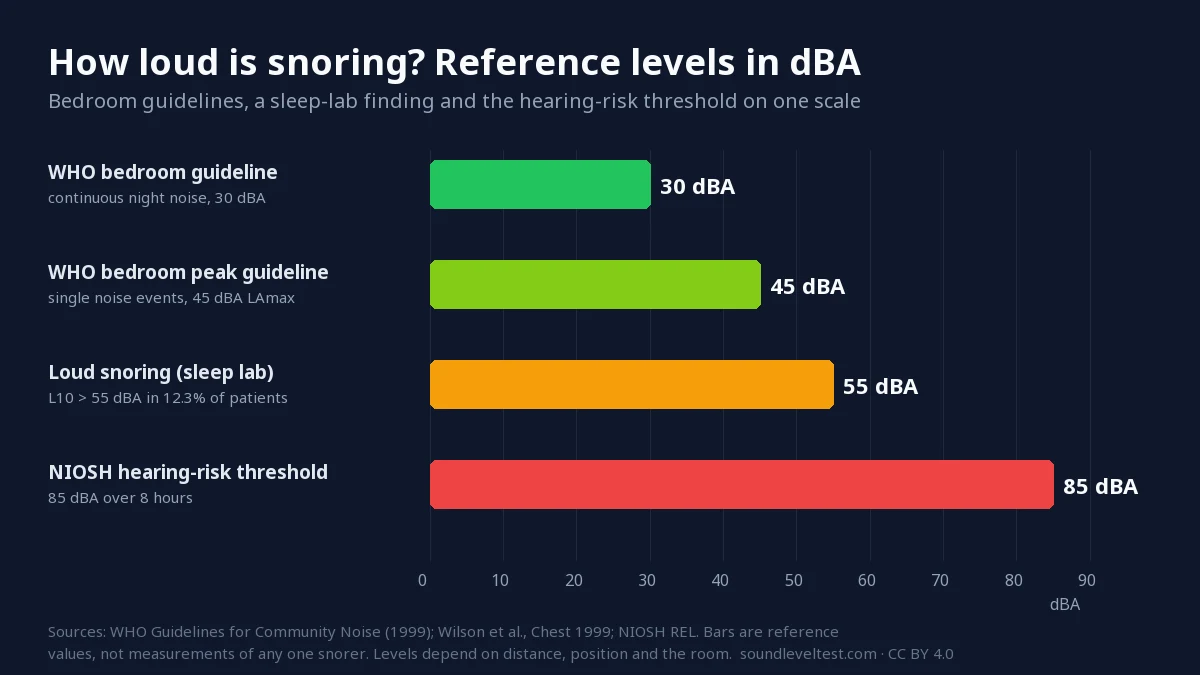
Snoring is usually around 40 to 60 dBA measured near the bed. Loud snorers regularly pass 55 dBA, well above the WHO's 30 dBA guideline for a bedroom at night, but far below the 85 dBA level linked to hearing damage.
Written by Nayeem, Software Developer of SoundLevelTest.com
Published:
Researched and compiled from published guidance by NIOSH, OSHA, CDC, and the WHO.
Typical sound level
| Sound | Typical level | Measured at |
|---|---|---|
| Light to loud snoring | 40–60 dBA | Near the bed, about 1 metre |
How it compares to other sounds
| Level | Typical sound | Safe daily exposure |
|---|---|---|
| 30 dB | Whisper, quiet bedroom at night | No exposure limit |
| 40 dB | Library, quiet suburb | No exposure limit |
| 50 dB | Refrigerator, moderate rainfall | No exposure limit |
| 60 dB | Normal conversation, dishwasher | No exposure limit |
| 85 dB | Heavy traffic, noisy restaurant, gas lawn mower | 8 hours |
Rows are taken from the full decibel chart. Safe exposure follows the NIOSH recommended exposure limit of 85 dBA for eight hours with a 3 dB exchange rate.
Can this level affect your hearing?
Almost never. Even loud snoring sits roughly 25 to 30 dB below the 85 dBA eight-hour threshold, and each 3 dB drop halves the sound energy. The realistic harm is to sleep: the WHO recommends bedroom noise stay near 30 dBA, with single events under 45 dBA, so snoring at 55 dBA can repeatedly wake a partner.
Snoring decibel levels at a glance
| Level | What it means | Source |
|---|---|---|
| 30 dBA | Recommended continuous noise in a bedroom at night | WHO, 1999 |
| 45 dBA | Recommended maximum for single noise events in a bedroom | WHO, 1999 |
| 55 dBA | Exceeded 10% of the night by 12.3% of sleep-lab patients | Wilson et al., 1999 |
| 85 dBA | Eight-hour level where hearing risk begins | NIOSH |
Why snoring seems louder than the numbers
A quiet bedroom often sits near 30 dBA, so a 55 dBA snore is about 25 dB above the background, which most people hear as several times louder. Snoring is also irregular: sudden peaks after a quiet pause are more disruptive than a steady sound of the same average level. Distance matters too; a partner whose ear is 30 cm away hears noticeably more than a meter placed across the room.
How to measure snoring at home
- Put your phone on the bedside table, about 1 metre from the snorer's head, and keep that distance every night.
- Measure the quiet room first with the sound level test so you know the background level.
- Start the noise logger with a threshold around 50 dB to record timestamped peaks overnight.
- Compare nights rather than trusting a single number; phone microphones are not calibrated. See the measurement methodology.
When to talk to a doctor
According to the American Academy of Sleep Medicine, loud snoring together with pauses in breathing, choking or gasping, or heavy daytime sleepiness can point to obstructive sleep apnea. A decibel reading cannot diagnose this. This page is general information, not medical advice.
Frequently asked questions
How many decibels is normal snoring?
Light to moderate snoring is commonly in the 40 to 60 dBA range measured near the bed. In a sleep-lab study of 1,139 patients, only 12.3% had snoring that exceeded 55 dBA for 10% of the night.
Can snoring damage hearing?
Very unlikely. Typical snoring is far below the 85 dBA level where NIOSH says hearing risk begins over eight hours. Its real cost is disturbed sleep for the snorer's partner.
Is loud snoring a sign of sleep apnea?
Loud, frequent snoring with pauses in breathing, gasping or daytime sleepiness can be a warning sign of obstructive sleep apnea. Only a clinician and a sleep study can diagnose it; a sound meter cannot.
Can I measure snoring with my phone?
Yes, as a rough guide. Place the phone on a bedside table at a fixed distance and use the noise logger to record peaks overnight. Phone microphones are not calibrated, so treat readings as comparisons between nights.
Sources
Wilson et al., The snoring spectrum, Chest (1999) — snoring intensity measured in 1,139 sleep-lab patients.
WHO, Guidelines for Community Noise (1999) — 30 dBA continuous and 45 dBA peak bedroom guidelines.
American Academy of Sleep Medicine, Snoring — warning signs of sleep apnea.
NIOSH, Understanding noise exposure — the 85 dBA threshold.
The 40–60 dBA range is a general guide, not a clinical measurement. Levels vary by person, night, position and distance.