How many decibels is too loud?
Sound becomes risky at about 85 decibels sustained over an eight-hour day. Above that, the safe time halves for roughly every 3 dB of extra loudness, so 100 dB is safe for around fifteen minutes and 115 dB for less than a minute.
Written by Nayeem, Software Developer of SoundLevelTest.com
Published: · Last updated:
Researched and compiled from published guidance by NIOSH, OSHA, CDC, and the WHO.
Measure your current level first, then read your reading against the limits below.
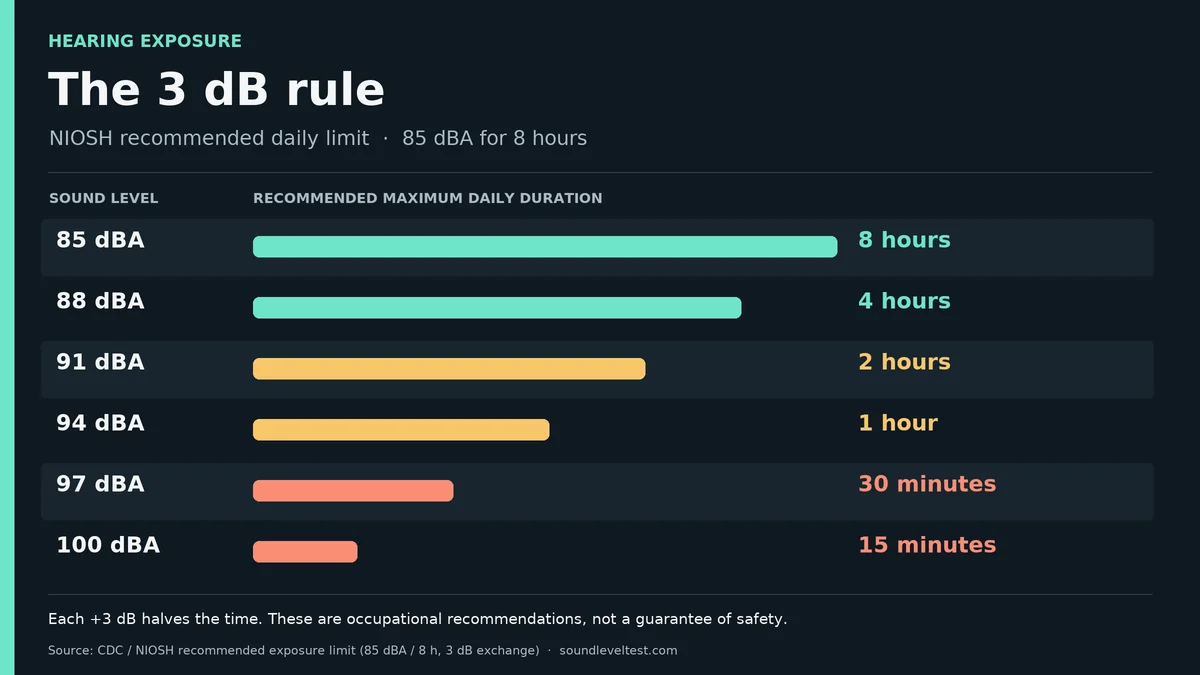
Safe listening time by decibel level
| Sound level | Maximum per day |
|---|---|
| 85 dBA | 8 hours |
| 88 dBA | 4 hours |
| 91 dBA | 2 hours |
| 94 dBA | 1.0 hours |
| 97 dBA | 30 minutes |
| 100 dBA | 15 minutes |
| 103 dBA | 7.5 minutes |
| 106 dBA | 3.8 minutes |
| 109 dBA | 1.9 minutes |
| 112 dBA | 56 seconds |
| 115 dBA | 28 seconds |
Source: NIOSH recommended exposure limit (85 dBA / 8 hours, 3 dB exchange rate). US workplace enforcement under OSHA uses a more permissive 90 dBA / 8 hours with a 5 dB exchange rate. See also CDC guidance on preventing noise-induced hearing loss. Work out a full shift with the OSHA vs NIOSH noise exposure calculator.
Common situations
Headphones
The WHO Make Listening Safe guidance is 80 dB for up to 40 hours a week for adults, and 75 dB for children. As a rough check, if you cannot hear someone speaking at arm's length, your headphones are too loud.
Babies and infants
Children can be exposed to damaging noise at home and at events. Keep noisy toys away from a child's ears, move away from loud sound sources, reduce listening volume, and use properly fitted hearing protection when loud noise cannot be avoided. See CDC guidance on preventing hearing loss in children.
Neighbours, apartments and night-time noise
Residential noise rules vary by city and may use different limits for daytime, night-time, property boundaries and specific sources. Check your local noise ordinance before relying on a number. A timed measurement with start time, duration and maximum level is far more useful in a complaint than a single peak reading.
Classrooms and study spaces
A classroom is rarely loud enough to harm hearing, but it is often too loud to learn in. The ANSI/ASA S12.60 standard sets 35 dBA for an empty classroom, and a busy room at 65–70 dB makes speech hard to follow for younger pupils and those learning in another language. A classroom noise monitor lets the class see its own level against a target for each activity.
Workplaces
A browser measurement is a useful screening step, not a compliance record. Occupational assessments require a calibrated Class 1 or Class 2 sound level meter or a personal dosimeter, under OSHA's occupational noise exposure standard and NIOSH noise guidance.
Warning signs you were exposed to too much noise
- Ringing or buzzing in your ears after leaving a venue
- Muffled hearing that takes hours to clear
- Needing to shout to be heard at arm's length
- Ear pain or a feeling of fullness