
Decibel addition calculator
Add sound levels the right way, or take background noise out of a reading.
Published:
Combined level
63.0 dB
10 · log₁₀(10^(60/10) + 10^(60/10)) = 63.0 dB
- Source 1 (60 dB): 50.0% of total sound power
- Source 2 (60 dB): 50.0% of total sound power
Built by Nayeem, Software Developer of SoundLevelTest.com
Latest update: First published with a multi-source decibel addition calculator, background noise subtraction, a two-source increment table and an original logarithmic addition chart.
How to add decibels: the short answer
- Formula: L = 10 × log10(10^(L1/10) + 10^(L2/10) + …).
- Two equal sources add 3 dB: 60 dB + 60 dB = 63 dB.
- Sources 10 dB apart: the quieter adds only about 0.4 dB (80 + 70 = 80.4 dB).
- Ten equal sources add 10 dB; identical in-phase tones add up to 6 dB.
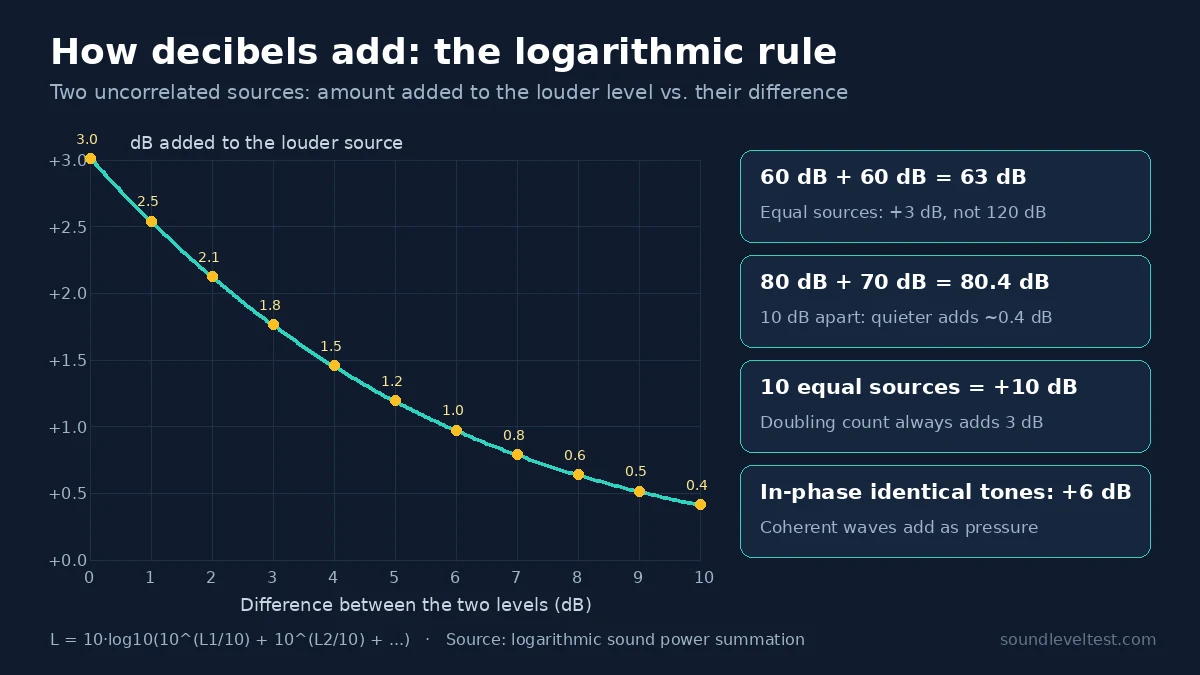
Decibel addition table for two sources
| Difference between levels | Add to the louder level |
|---|---|
| 0 dB | +3.0 dB |
| 1 dB | +2.5 dB |
| 2 dB | +2.1 dB |
| 3 dB | +1.8 dB |
| 4 dB | +1.5 dB |
| 5 dB | +1.2 dB |
| 6 dB | +1.0 dB |
| 7 dB | +0.8 dB |
| 8 dB | +0.6 dB |
| 9 dB | +0.5 dB |
| 10 dB | +0.4 dB |
Incoherent vs coherent addition
Most real sources — machines, voices, traffic — are uncorrelated, so their sound power adds and two equal sources give +3 dB. Only identical signals that stay in step, like one tone fed to two speakers, add as pressure and can reach +6 dB at a spot where they arrive in phase; a little further away they may partly cancel. This calculator uses the uncorrelated (power) rule, which is the right one for everyday noise.
Limits and good practice
The maths is exact, but the result is only as good as your readings. Use the same weighting for every value, measure from the same spot, and remember that phone and browser meters are approximate. Take readings with the sound level meter, learn why weighting matters in dB vs dBA, compare levels on the decibel chart, or turn a combined level into safe hours with the noise exposure calculator.
Questions people ask
How do you add decibels?
Convert each level to relative sound power with 10^(L/10), add those numbers, then convert back with 10 × log10 of the sum. Decibels are logarithmic, so you cannot add them like ordinary numbers.
Why is 60 dB + 60 dB = 63 dB and not 120 dB?
Two equal, unrelated sources double the sound power. Doubling power raises the level by 10 × log10(2), which is about 3 dB. To reach 120 dB you would need a million times the sound power.
How many dB does doubling the number of sources add?
About 3 dB each time you double the number of equal sources: 2 sources add 3 dB, 4 add 6 dB, 8 add 9 dB and 10 add 10 dB.
If one source is 10 dB louder, does the quieter one matter?
Barely. At a 10 dB difference the quieter source adds only about 0.4 dB. Once the gap exceeds about 10 dB, the louder source dominates the total.
When do two sounds add 6 dB instead of 3 dB?
When they are coherent: identical signals arriving exactly in phase, such as the same tone from two speakers at the same distance. Their pressures add, giving 20 × log10(2) ≈ 6 dB. Out of phase they can cancel. Everyday noise sources are uncorrelated and add about 3 dB.
How do I remove background noise from a measurement?
Measure the total with the source on, then the background with it off. Subtract the powers: 10 × log10(10^(Total/10) − 10^(Background/10)). If the difference is over 10 dB the correction is negligible; under 3 dB the result is too uncertain to trust.
Does this work for dBA readings?
Yes, as long as every value uses the same weighting (all dBA or all dBC). Do not mix weightings in one sum. See dB vs dBA for how weighting works.