White noise generator
White, pink and brown noise with a sleep timer. Start quiet.
Published:
Balanced, like steady rain · best for sleep and general relaxation
Built by Nayeem, Software Developer of SoundLevelTest.com
Latest update: First published with white, pink and brown noise, a fading sleep timer, a comparison table and an original spectral-slope chart.
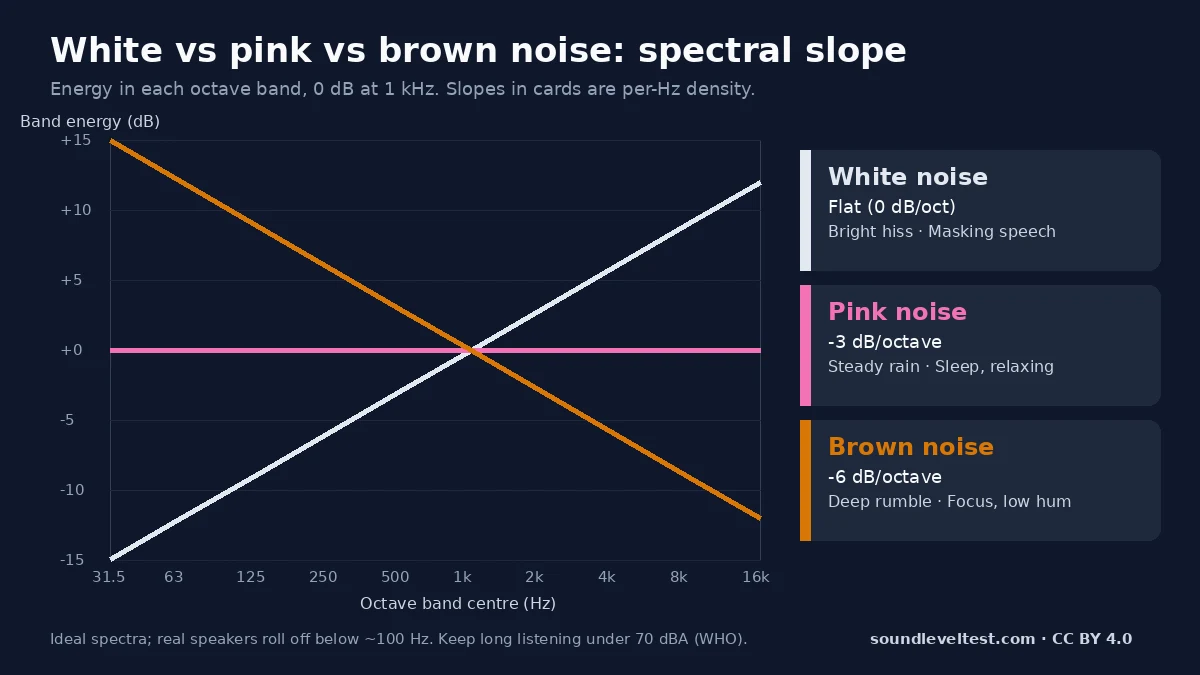
Short answer: white noise is flat across all frequencies and sounds like a hiss; pink noise drops 3 dB per octave and sounds like rain; brown noise drops 6 dB per octave and sounds like a low rumble. Pick the one you find easiest to ignore, and keep the volume low.
White vs pink vs brown noise
| Colour | Spectral slope | Sounds like | Common uses |
|---|---|---|---|
| White | 0 dB/octave (flat per Hz) | Bright hiss, like TV static | Masking speech, office chatter, tinnitus checks with a clinician |
| Pink | -3 dB/octave | Balanced, like steady rain | Sleep, relaxing, testing room acoustics |
| Brown (red) | -6 dB/octave | Deep rumble, like a waterfall | Focus, masking traffic and low hum |
How the noise is made
The page fills eight seconds of audio with random samples and loops it. White noise uses the samples as they are. Pink noise passes them through a set of simple filters (Paul Kellet's method) that tilt the spectrum down by 3 dB per octave. Brown noise integrates the samples, with a small leak so the signal does not drift, which gives the steeper 6 dB per octave slope. Every start, stop and colour change fades in or out to avoid clicks.
Listening safely
Noise that plays for hours should be quiet. The WHO recommends keeping long-term average exposure below about 70 dBA, and steady noise above 85 dBA over a working day can damage hearing. For babies, place any speaker well away from the cot and keep it soft. Measure the level at your pillow with the sound level meter, compare it on the decibel chart, or work out safe hours with the noise exposure calculator. If you have tinnitus or sleep problems, talk to a doctor or audiologist; this page is not medical advice.
Want a single steady pitch instead of noise? Use the tone generator.
Questions people ask
What is a white noise generator?
A white noise generator plays a random signal that contains every audible frequency at equal power per hertz. It sounds like a steady hiss. This one synthesises the sound in your browser, so there is nothing to install and no audio is recorded.
What is the difference between white, pink and brown noise?
They differ in how power is spread across frequencies. White noise is flat per hertz, so it sounds bright. Pink noise falls by 3 dB per octave, giving each octave equal energy and a softer, rain-like sound. Brown noise falls by 6 dB per octave and sounds like a deep rumble.
Is pink or brown noise better for sleep?
There is no single best colour. A few small studies have linked pink noise to steadier deep sleep, but the evidence is limited and results vary between people. Many listeners find brown noise more comfortable because it has less hiss. Try each at a low volume and keep the one you find least noticeable.
Does brown noise help with ADHD or focus?
Many people say brown noise helps them concentrate, and some research suggests background noise can help certain people with attention difficulties. The evidence is still early and not specific to brown noise. It is not a treatment for ADHD; speak to a doctor about diagnosis or care.
How loud should white noise be for sleep?
Keep it quiet: roughly the level of a soft shower, well below normal conversation. The WHO advises keeping long-term listening below about 70 dBA, and for infants many paediatric guidelines suggest around 50 dBA with the source placed away from the cot. You can check the level with our sound meter.
How does the sleep timer work?
Choose 15, 30, 45 or 60 minutes before or while the noise plays. In the last ten seconds the volume fades smoothly to silence, so the sound does not cut off abruptly and wake you.
Will the noise keep playing with my screen off?
That depends on your device. Desktop browsers keep playing in a background tab. Some phones pause web audio when the screen locks or the battery saver is on, so leave the page open and check your settings before relying on it overnight.
Is anything recorded or uploaded?
No. The generator only plays sound. It never asks for your microphone, and the noise is created on your device with the Web Audio API.