
How loud is a dog bark?
A dog bark typically measures 90 to 100 decibels about a metre away, with large breeds reaching higher. The level drops quickly with distance, so the same bark heard from across a garden is far quieter than one beside your ear.
Written by Nayeem, Software Developer of SoundLevelTest.com
Last updated: (originally published )
Researched and compiled from published guidance by NIOSH, OSHA, CDC, and the WHO.
How loud is a dog bark in decibels?
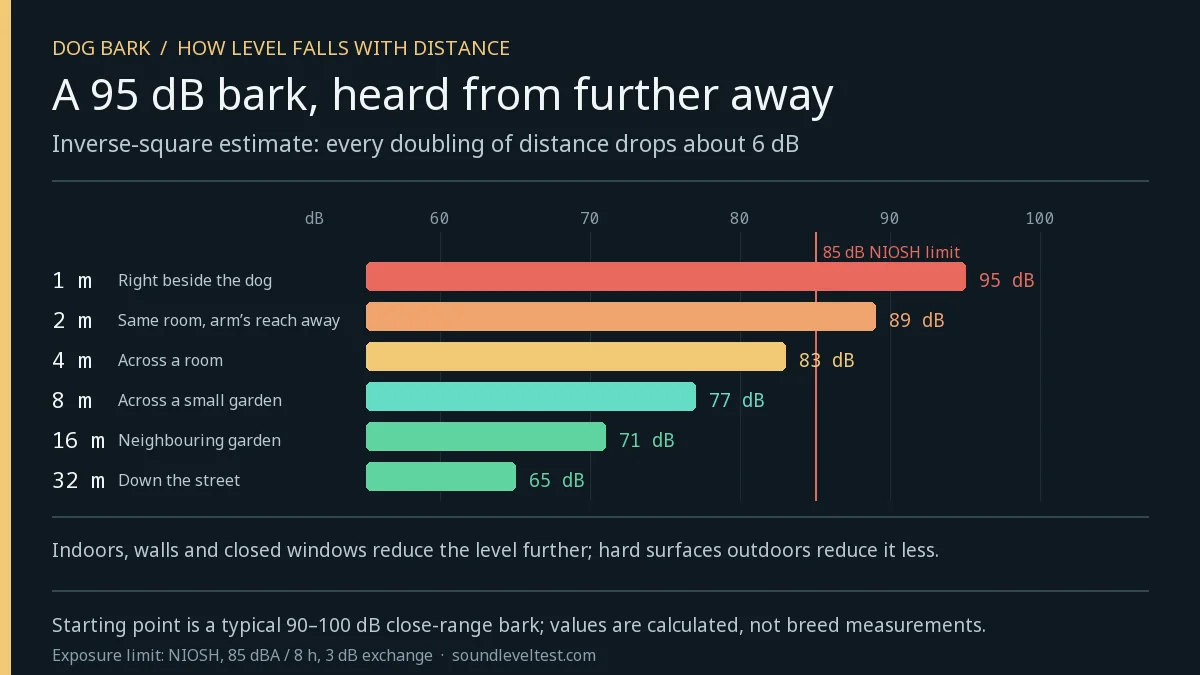
A typical dog bark measures about 90 to 100 dB at 1 metre, with large breeds at the upper end. Loudness falls with distance, so the same bark is roughly 71 dB from a neighbour's garden 16 metres away. Short bursts rarely harm hearing, but repeated barking can disturb sleep.
- Typical bark, about 1 metre away: 90–100 dB, louder for large breeds
- Across a room or small yard (4 metres): about 83 dB for a 95 dB bark
- From a neighbour's garden (16 metres): about 71 dB in open air
- Hearing-risk reference: NIOSH uses 85 dBA over 8 hours; 100 dBA allows about 15 minutes a day
Distance figures are open-air estimates (about 6 dB less per doubling of distance), not breed measurements. Two dogs barking together are not twice as loud: the decibel addition calculator shows the combined level, and the 90 dB benchmark on the decibel chart compares barking with everyday sounds.
If a neighbour's dog barks for long periods, check your room with the live sound level meter and keep timestamped notes in the noise complaint logger.
Typical sound level
| Sound | Typical level | Measured at |
|---|---|---|
| Single bark, medium to large dog | 90–100 dB | About 1 metre from the dog |
How it compares to other sounds
| Level | Typical sound | Safe daily exposure |
|---|---|---|
| 70 dB | Vacuum cleaner, busy office, shower | No exposure limit |
| 85 dB | Heavy traffic, noisy restaurant, gas lawn mower | 8 hours |
| 90 dB | Hair dryer at close range, blender | 3 hours |
| 100 dB | Nightclub, handheld drill, sporting event | 15 minutes |
Rows are taken from the full decibel chart. Safe exposure follows the NIOSH recommended exposure limit of 85 dBA for eight hours with a 3 dB exchange rate.
Can this level affect your hearing?
A single bark is brief, so it is unlikely to damage hearing on its own. Repeated close-range barking — in a kennel, a shelter or a car — is a different matter, because the dose accumulates across the day. At 100 dB the safe daily total is only a few minutes of actual sound.
How to document a neighbour's barking dog
If barking keeps disturbing you, a calm record of when it happens is more useful than a single loud reading. Landlords, homeowners' associations and local councils usually want to see a pattern over several days before they act.
- Talk to the neighbour first if it feels safe; many owners do not know their dog barks while they are out.
- Keep a diary of dates, start and end times, and how the barking affected you, such as sleep or work interrupted.
- Use the free noise complaint logger to record timestamped loud periods with their peak and average levels. It keeps only times and levels, never audio.
- Repeat at the times barking usually happens, on several days, and note whether windows were open.
- Check your local noise rules or tenancy terms; quiet hours and limits differ by place.
Phone and laptop readings are estimates, not certified measurements. Treat your log as a personal diary that supports a complaint, and ask the responsible authority to measure if a formal decision depends on the level.
Sources
NIOSH, Criteria for a Recommended Standard: Occupational Noise Exposure: exposure limits used in the comparison table.
NIOSH, Noise and Hearing Loss Prevention: background on impulse and repeated noise.
The range above is a general comparison value, not a breed-specific measurement. Actual levels vary by dog, distance and environment.