
Microphone frequency detector
Find the pitch of any note in Hz, plus the nearest musical note.
Published:
Frequency
--
Nearest note
--
Sing, hum or play a note
Band
--
Audio is analysed on your device and never uploaded.
Built by Nayeem, Software Developer of SoundLevelTest.com
Latest update: First published with live microphone pitch detection (Hz, nearest note, cents), voice range table and an original audio frequency spectrum chart.
What is a frequency detector?
A frequency detector listens through your microphone and measures how many times per second a sound repeats, shown in hertz (Hz). For a sung or played note it reports the fundamental frequency, the nearest note (A4 = 440 Hz) and the tuning error in cents.
- Voice / instrument mode: autocorrelation pitch tracking from 50 Hz to 2,000 Hz.
- Tone / whistle mode: strongest spectral peak from 20 Hz up to about 20 kHz.
- Each octave doubles the frequency: A3 = 220 Hz, A4 = 440 Hz, A5 = 880 Hz.
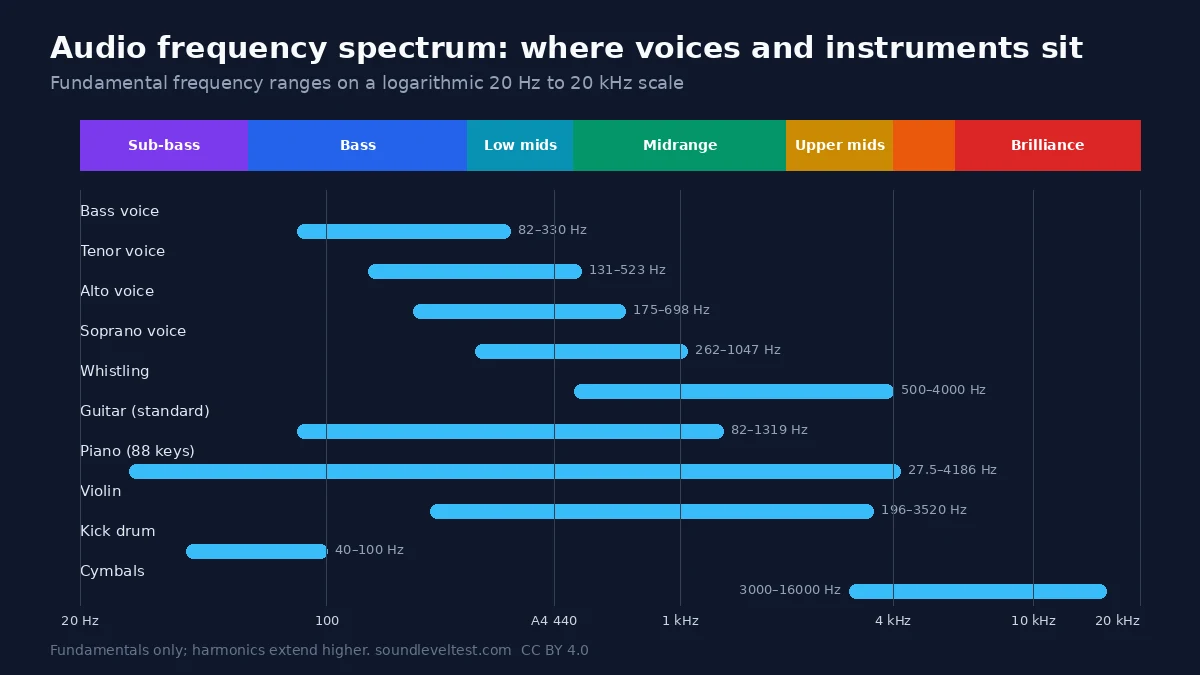
Singing voice frequency ranges
| Voice type | Typical notes | Frequency |
|---|---|---|
| Bass | E2–E4 | 82–330 Hz |
| Baritone | G2–G4 | 98–392 Hz |
| Tenor | C3–C5 | 131–523 Hz |
| Alto | F3–F5 | 175–698 Hz |
| Mezzo-soprano | A3–A5 | 220–880 Hz |
| Soprano | C4–C6 | 262–1,047 Hz |
Ranges are typical trained-voice spans; individual voices vary.
How to get an accurate reading
- Use a quiet room and hold the phone or laptop mic about 15–30 cm away.
- Sing or play one steady note for at least a second; chords confuse any single-pitch detector.
- Pick Tone mode for whistles, test tones and sounds above 2 kHz.
- Choose the reference pitch your band or orchestra tunes to (440, 432 or 442 Hz).
Frequency is not loudness
Hertz tells you how high a sound is; decibels tell you how loud it is. To measure loudness use the sound level meter. To play a known frequency and check the detector, open the tone generator. To find the highest pitch your ears can hear, try the hearing age test, and see how frequency affects perceived loudness in dB vs dBA.
Questions people ask
How do I find the frequency of a sound?
Press Start, allow the microphone, then hold a steady note close to the mic. The detector shows the fundamental frequency in hertz, the nearest note and how far it is from that note in cents.
What Hz is my voice?
Typical speaking pitch is roughly 85–180 Hz for adult male voices and 165–255 Hz for adult female voices. Singing ranges reach higher: a bass covers about 82–330 Hz and a soprano about 262–1,047 Hz. Use the Voice mode and slide through your range to see your lowest and highest notes.
What is the difference between pitch and frequency?
Frequency is a physical measurement in hertz (cycles per second). Pitch is how high or low we perceive a sound. For a steady tone they match closely, so a 440 Hz tone is heard as the note A4.
What do cents mean?
A cent is 1/100 of a semitone. A reading of +20 cents means you are slightly sharp of the nearest note; -20 cents means slightly flat. Most listeners notice errors of about 10 cents or more on sustained notes.
Why does the detector jump between octaves?
Voices and instruments contain strong harmonics at 2×, 3× and higher multiples of the fundamental. Breathy notes, background noise or a weak fundamental can make any detector briefly lock to a harmonic. Sing a clear vowel like 'ah' closer to the microphone.
What is the highest frequency a phone microphone can detect?
Most browsers sample at 44.1 or 48 kHz, so the theoretical limit (Nyquist) is about 22–24 kHz. In practice many phone and laptop mics roll off above 15–18 kHz, so very high tones may read low or not at all.
Is my microphone audio recorded or uploaded?
No. The audio is analysed in your browser with the Web Audio API and is never stored or sent to a server.