dB vs dBA: what's the difference?
Written by Nayeem, Software Developer of SoundLevelTest.com
Published:
Researched and compiled from published guidance by NIOSH, OSHA, CDC, and the WHO.
Quick answer
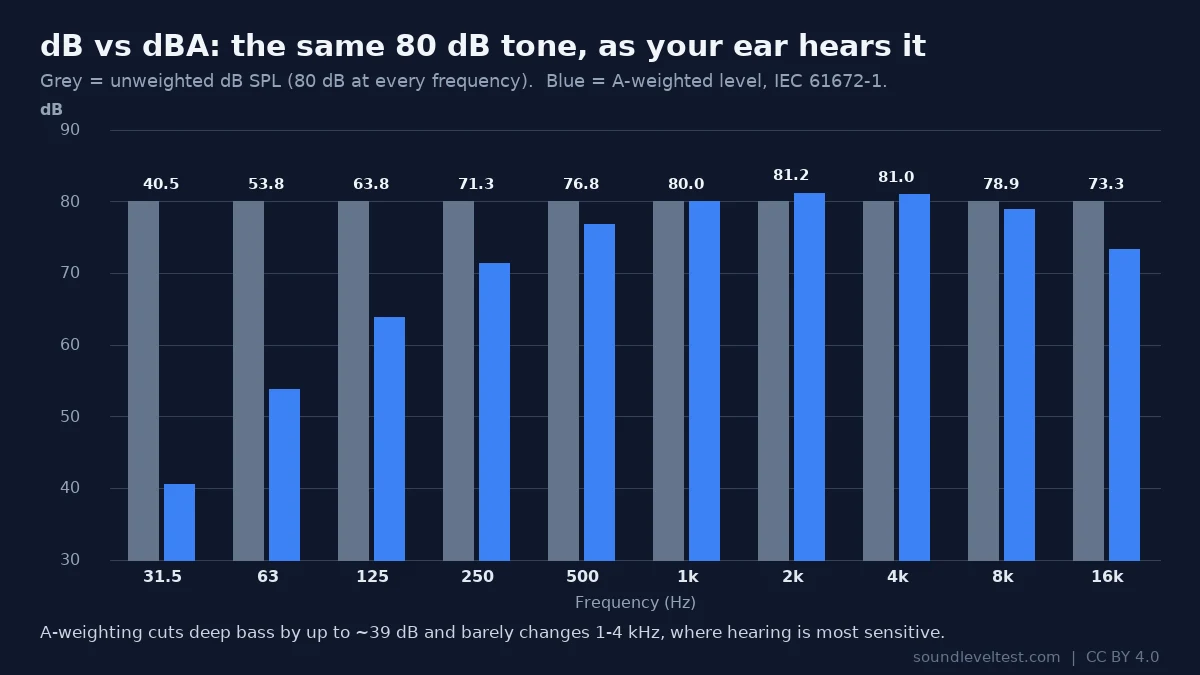
dB is the raw sound pressure level, with every frequency counted equally. dBA passes the same sound through the A-weighting filter defined in IEC 61672-1, which reduces deep bass (by about 39 dB at 31.5 Hz) and very high treble to roughly match human hearing. Speech-range sounds near 1–4 kHz barely change.
Try it: convert a tone from dB to dBA
Tone frequency
80 dB at 63 Hz ≈ 53.8 dBA (A-weighting -26.2 dB)
Valid for a single steady tone. Real noise mixes many frequencies, so it needs a full spectrum to convert.
A-weighting at common frequencies
| Frequency | Typical sound | A-weighting | 80 dB tone reads |
|---|---|---|---|
| 31.5 Hz | Sub-bass rumble, distant thunder | -39.5 dB | 40.5 dBA |
| 63 Hz | Engine idle, subwoofer | -26.2 dB | 53.8 dBA |
| 125 Hz | Low bass notes, mains hum harmonics | -16.2 dB | 63.8 dBA |
| 250 Hz | Lower range of male voices | -8.7 dB | 71.3 dBA |
| 500 Hz | Speech vowels | -3.2 dB | 76.8 dBA |
| 1 kHz | Reference tone; no correction | 0.0 dB | 80.0 dBA |
| 2 kHz | Speech consonants | +1.2 dB | 81.2 dBA |
| 4 kHz | Whistles, baby cries, alarms | +1.0 dB | 81.0 dBA |
| 8 kHz | Cymbals, hiss | -1.1 dB | 78.9 dBA |
| 16 kHz | Very high hiss near the top of hearing | -6.7 dB | 73.3 dBA |
What a decibel measures
Sound pressure level compares the measured pressure p with the quietest pressure a young ear can detect, 20 micropascals: L = 20 × log10(p ÷ 20 µPa). Because the scale is logarithmic, +6 dB means double the pressure and +10 dB sounds roughly twice as loud. Plain dB treats a 30 Hz rumble and a 3 kHz whistle the same, even though we hear the whistle far more easily.
Why you can't convert one dB number to dBA
The A-weighting correction changes with frequency, so a single dB figure doesn't say how much to subtract. A sound level meter splits the noise into frequency bands, corrects each band, then adds them back on an energy basis. Example: 80 dB at 63 Hz plus 80 dB at 1 kHz is 83 dB unweighted, but about 80.0 dBA, because the bass band drops to 53.8 dBA and adds almost nothing.
Why noise limits use dBA
Hearing-safety rules are written in A-weighted levels. The NIOSH recommended exposure limit is 85 dBA for eight hours, and OSHA uses dBA for workplace noise. See how loud is too loud for safe times at each level. For loud bass or peak sounds, engineers often add a C-weighted reading; the dBA vs dBC comparison explains that difference.
What this site's meter shows
The sound level test applies no A-weighting. It shows an unweighted estimate shaped by your phone or laptop microphone, which already rolls off deep bass on most devices. Readings are useful for comparisons, not certified dBA measurements. Want to hear the effect? Play the same volume at 50 Hz and 1 kHz in the tone generator; keep the volume low.
Frequently asked questions
What is the difference between dB and dBA?
dB (sound pressure level) counts every frequency equally. dBA applies the A-weighting filter from IEC 61672-1, which reduces low and very high frequencies to roughly match how sensitive human hearing is at moderate levels.
Can I convert dB to dBA with one formula?
Not from a single number. The correction depends on frequency, so you need the sound's spectrum. For a pure tone you can add the A-weighting value for that frequency; for real noise each frequency band is corrected and then the bands are added together on an energy basis.
Is dBA always lower than dB?
Usually, because most everyday noise contains low-frequency energy that A-weighting reduces. For sound concentrated between about 1 and 5 kHz, the dBA value can be equal to or slightly higher than the unweighted level.
Why do hearing limits use dBA?
Occupational limits such as the NIOSH 85 dBA recommended exposure limit and OSHA rules are written in A-weighted levels because A-weighting tracks the risk to hearing from everyday noise better than an unweighted reading.
Does this site's sound meter show dB or dBA?
Neither exactly. The browser meter shows an unweighted estimate shaped by your device's microphone and processing. It applies no A-weighting, so treat its number as an approximate dB reading, not a certified dBA measurement.