How loud is a baby crying?
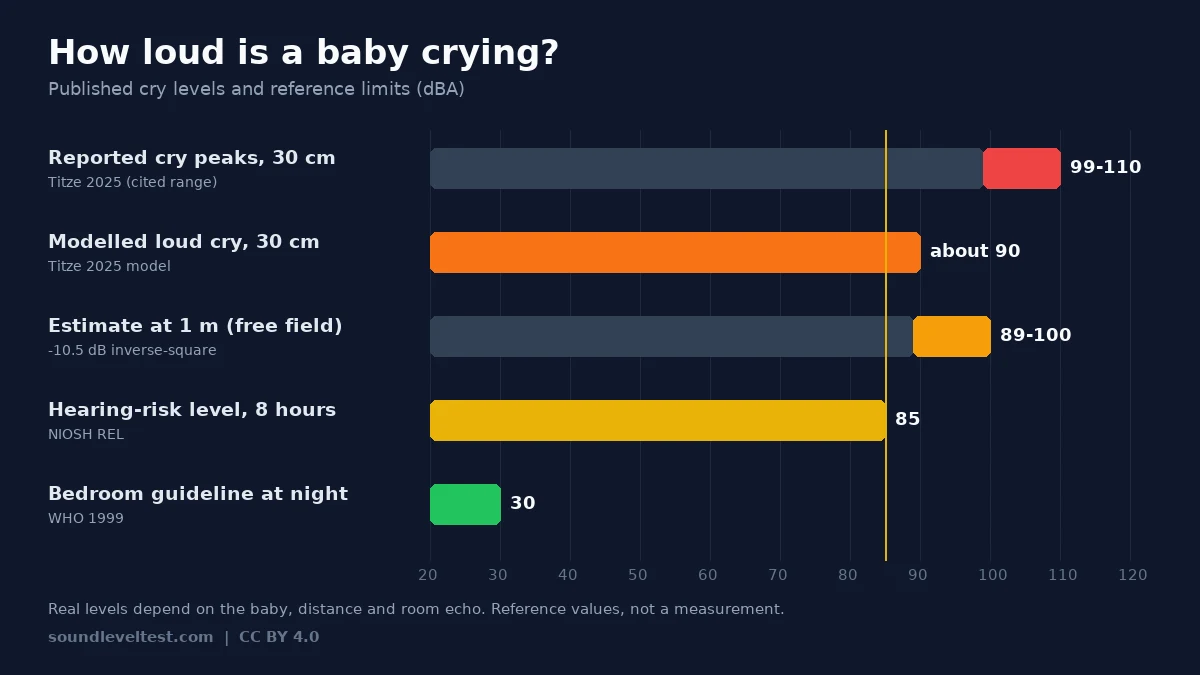
A loud infant cry is reported at about 99 to 110 dBA 30 cm from the mouth. A metre away it drops by roughly 10 dB, but it can still sit above the 85 dBA level used for long-term hearing risk.
Written by Nayeem, Software Developer of SoundLevelTest.com
Published:
Researched and compiled from published guidance by NIOSH, OSHA, CDC, and the WHO.
Typical sound level
| Sound | Typical level | Measured at |
|---|---|---|
| Loud newborn cry | 99–110 dBA | 30 cm from the mouth |
How it compares to other sounds
| Level | Typical sound | Safe daily exposure |
|---|---|---|
| 60 dB | Normal conversation, dishwasher | No exposure limit |
| 85 dB | Heavy traffic, noisy restaurant, gas lawn mower | 8 hours |
| 90 dB | Hair dryer at close range, blender | 3 hours |
| 100 dB | Nightclub, handheld drill, sporting event | 15 minutes |
| 110 dB | Rock concert, chainsaw, car horn at 1 m | 1.5 minutes |
Rows are taken from the full decibel chart. Safe exposure follows the NIOSH recommended exposure limit of 85 dBA for eight hours with a 3 dB exchange rate.
Can this level affect your hearing?
Rarely, because cries come in bursts rather than eight-hour stretches. NIOSH sets 85 dBA for eight hours and halves the safe time for every 3 dB above that, so 100 dBA allows about 15 minutes a day. If you spend long spells holding a screaming baby against your shoulder, turn your head away a little; a few centimetres of extra distance noticeably lowers the level at your ear.
Baby crying decibel levels at a glance
| Level | What it means | Source |
|---|---|---|
| 99–110 dBA | Reported loud newborn cry, 30 cm from the mouth | Titze, 2025 (cited range) |
| About 90 dB | Computer-modelled loud cry, 30 cm from the mouth | Titze, 2025 (model) |
| 89–100 dBA | Estimate 1 m away in open space (−10.5 dB) | Inverse-square calculation |
| 85 dBA | Eight-hour level where hearing risk begins | NIOSH |
| 30 dBA | Recommended bedroom level at night | WHO, 1999 |
Why distance matters so much
In open space, sound drops about 6 dB each time the distance doubles. Going from 30 cm to 1 m is just over three times the distance, about 10.5 dB less. Indoors, walls and floors reflect sound, so the drop is usually smaller. A closed door between rooms cuts the level much more than distance alone.
Why a cry feels louder than its number
Much of a cry's energy falls between about 2 and 4 kHz, the range our ears are most sensitive to. It is also rough and irregular, which makes it hard to ignore. That is a feature: it is how babies get attention. Two sounds with the same dBA reading can feel very different.
How to measure a crying baby at home
- Measure the quiet room first with the sound level test.
- Keep the phone at a fixed distance, for example 1 metre from the cot, and note the Max reading.
- To see how much a door or another room helps, use the noise logger in that room.
- Phone microphones are not calibrated and can clip at high levels, so treat readings as estimates. See the measurement methodology.
When to call a doctor
Crying is normal communication, and a sound meter cannot tell you why a baby cries. The American Academy of Pediatrics suggests calling your paediatrician if crying seems unusual or won't settle, or comes with fever, vomiting, poor feeding or breathing trouble. If you feel overwhelmed, put the baby down safely in the cot and take a short break. This page is general information, not medical advice.
Frequently asked questions
How many decibels is a baby crying?
Published research describes loud newborn cries at about 99 to 110 dBA measured 30 cm from the mouth. Ordinary fussing is quieter, and the level falls quickly as you move away.
Can a crying baby damage a parent's hearing?
Crying comes in short bursts, so it rarely adds up to the long daily exposure that NIOSH links to hearing damage. Holding a screaming baby right next to your ear for long periods is the closest case; turning your head slightly away lowers the level at your ear.
Why does a baby's cry sound so loud?
Infants push air at high lung pressure through a small airway, and their cry energy sits around 2 to 4 kHz, where human hearing is most sensitive. That makes a cry seem louder than its decibel number suggests.
Should I use a sound meter to judge if my baby is unwell?
No. Loudness does not tell you whether a baby is ill. Contact your doctor if crying sounds unusual, comes with fever, poor feeding or breathing trouble, or you are worried. This page is general information, not medical advice.
Sources
Titze, Aerodynamic and Acoustic Power in Infant Cry, Journal of Voice (2025) — cited 99–110 dB(A) at 30 cm and a modelled 90 dB at 30 cm.
NIOSH, Understanding noise exposure — 85 dBA and the 3 dB exchange rate.
WHO, Guidelines for Community Noise (1999) — 30 dBA bedroom guideline.
American Academy of Pediatrics, HealthyChildren.org — when to seek help for crying.
The 1 m figure is a calculation, not a measurement. Real levels vary by baby, age, distance and room.