How loud is traffic noise?
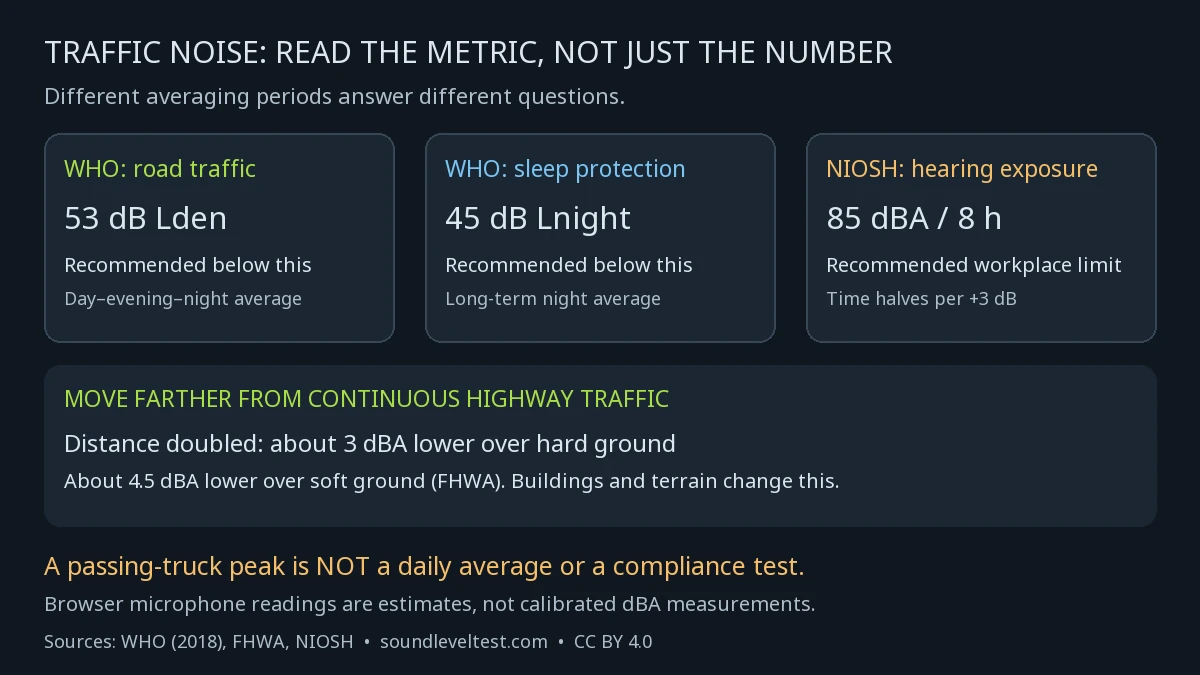
Traffic noise has no single decibel value: trucks, speed, distance and buildings all change it. For chronic road-traffic exposure, WHO recommends below 53 dB Lden and 45 dB Lnight. These are long-term averages, not passing-car peaks.
Written by Nayeem, Software Developer of SoundLevelTest.com
Published:
Researched and compiled from published guidance by NIOSH, OSHA, CDC, and the WHO.
Traffic noise levels: what the numbers mean
| Reference | Purpose | Averaging and limits | Source |
|---|---|---|---|
| Below 53 dB Lden | WHO road-traffic recommendation | Long-term day–evening–night level; evening +5 dB and night +10 dB penalties | WHO (2018) |
| Below 45 dB Lnight | WHO night-time recommendation | Long-term average during the defined night period | WHO (2018) |
| 67 dBA Leq(h) | US FHWA Category B abatement criterion | Hourly equivalent level for outdoor residential and other Category B uses; not a universal safe level | 23 CFR 772, Table 1 |
| 85 dBA / 8 hours | NIOSH workplace recommended exposure limit | Occupational daily exposure; permitted duration halves for each +3 dB | NIOSH |
Lden combines day, evening and night exposure with penalties for more sensitive periods. Lnight describes night exposure. Leq(h) is an energy-equivalent hourly level; a maximum or peak describes an event. A 70 dB passing truck does not establish that a home exceeds a WHO guideline. WHO guidance is not automatically a local legal limit; US highway abatement criteria are project-specific planning criteria.
Why a busy road gets quieter with distance
FHWA explains that continuous highway traffic behaves approximately like a line source: doubling distance gives about a 3 dBA decrease over hard ground, or 4.5 dBA over soft ground. That is different from the 6 dB rule for an isolated point source. Reflections between buildings, road elevation, weather and barriers can change either estimate.
Health: sleep and stress, not only hearing
WHO's environmental noise guidance considers sleep disturbance, annoyance and cardiovascular effects of long-term exposure. Being below a workplace hearing-exposure limit does not establish that traffic noise is harmless to sleep. Individual health risk cannot be diagnosed from a browser meter; seek a clinician for persistent symptoms. This is general information, not medical advice.
Near sustained loud traffic, follow hearing-exposure guidance: reduce time, increase distance and use appropriate hearing protection where needed. NIOSH's 85 dBA for eight hours is a recommended occupational limit, not a guarantee of safety for every person.
Compare traffic noise at home
- Stay in a safe location away from the roadway. Note the room or outdoor position, approximate road distance, date, time and weather.
- Use the same device and position with the sound level meter. Compare quiet and busy periods, and open versus closed windows.
- Use the noise logger for timestamped events and notes. Keep the tab active; its session average is not a validated Lden or Lnight calculation.
- For a planning or complaint assessment, ask your local authority what equipment, averaging period and procedure it requires. Browser readings cannot prove compliance.
No audio is recorded or uploaded. Microphone processing and calibration vary by device; readings are estimates, not calibrated dBA. Read our measurement methodology.
Ways to reduce road noise indoors
Try a bedroom on the quieter side of the building, seal window gaps and compare closed-window levels when ventilation and temperature allow. Effective highway barriers must interrupt the sound path; thin fences and vegetation are not substitutes for an engineered barrier. Ask an acoustics professional before investing in glazing or barrier work, especially for low-frequency truck rumble. No reduction is guaranteed for an individual property.
Frequently asked questions
How many decibels is road traffic noise?
There is no single traffic-noise level. It depends on vehicle mix, speed, traffic volume, distance, ground and barriers. Specify the location and whether a number is a passing-vehicle peak, an hourly Leq, or a long-term Lden or Lnight average.
What traffic noise level does WHO recommend?
WHO strongly recommends reducing road traffic noise below 53 dB Lden and below 45 dB Lnight. These are long-term environmental metrics, not limits for a single passing car and not universal legal limits.
How much does highway noise drop with distance?
FHWA describes roughly 3 dBA less per doubling of distance from a continuous highway line source over hard ground, or 4.5 dBA over soft ground. Reflections, barriers, terrain and isolated vehicles can change the result.
Can a phone prove a traffic noise limit was exceeded?
No. Browser microphone readings are uncalibrated estimates. They can help compare locations or times, but legal or planning assessments require the specified averaging period, suitable calibrated equipment and local procedures.
Can traffic noise affect health even below hearing-damage levels?
Yes. WHO considers sleep disturbance, annoyance and cardiovascular effects in its environmental guidance. Its traffic-noise recommendations address chronic exposure, not just hearing damage. This page is general information, not medical advice.
Sources
- WHO, Environmental Noise Guidelines for the European Region (2018) — road-traffic recommendations and health outcomes.
- FHWA, Highway Traffic Noise Analysis and Abatement Policy and Guidance: fundamentals — highway line sources and distance effects.
- 23 CFR Part 772, Table 1 — US highway noise abatement criteria.
- NIOSH, Understanding noise exposure — 85 dBA for eight hours and the 3 dB exchange rate.