Noise exposure calculator
OSHA vs NIOSH safe time and daily noise dose.
Published:
Safe time at one sound level
Daily noise dose for a full shift
Total time: 8 h. Levels under 80 dBA add no dose.
Above the OSHA action level (50%). A hearing conservation program is required.
Estimate only. It does not replace a workplace noise survey with a calibrated meter or dosimeter. Need a reading? Try the sound level meter (uncalibrated).
Built by Nayeem, Software Developer of SoundLevelTest.com
Quick answer
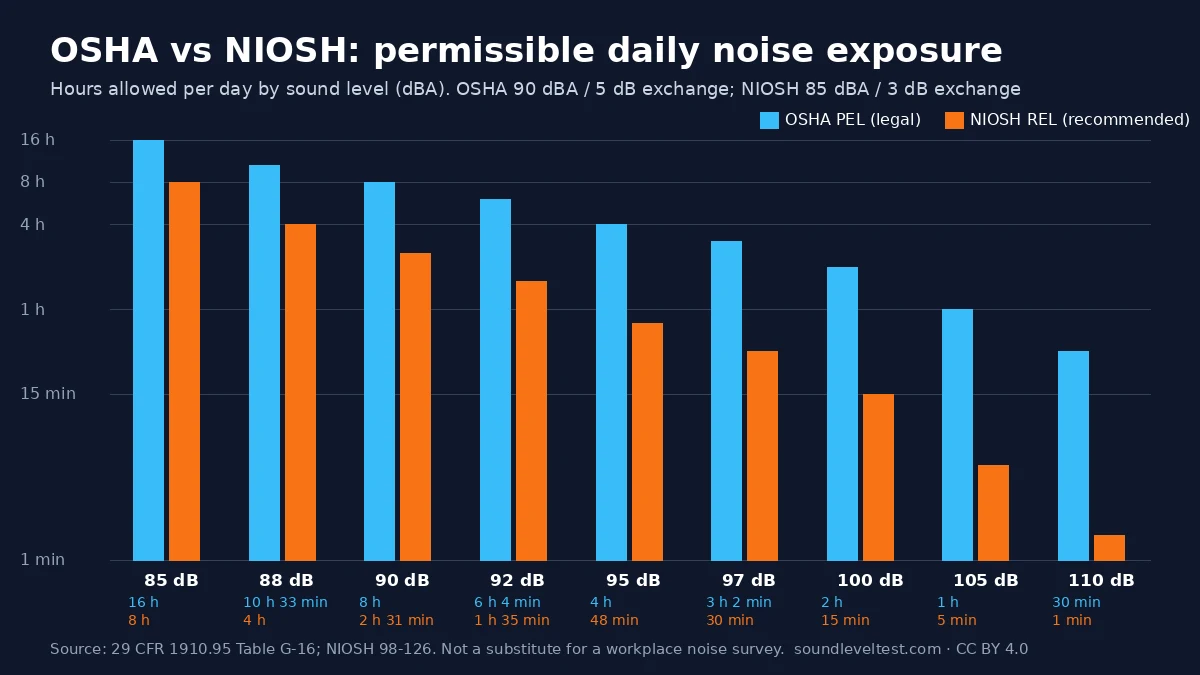
OSHA allows 8 hours at 90 dBA and halves the time every 5 dB. NIOSH recommends 8 hours at 85 dBA and halves the time every 3 dB. At 100 dBA that means 2 hours under OSHA but only 15 minutes under NIOSH.
Permissible noise exposure chart
| Level (dBA) | OSHA allowed time | NIOSH recommended time |
|---|---|---|
| 80 | 32 h | 25 h 24 min |
| 85 | 16 h | 8 h |
| 88 | 10 h 33 min | 4 h |
| 90 | 8 h | 2 h 31 min |
| 92 | 6 h 4 min | 1 h 35 min |
| 95 | 4 h | 48 min |
| 97 | 3 h 2 min | 30 min |
| 100 | 2 h | 15 min |
| 105 | 1 h | 5 min |
| 110 | 30 min | 1 min |
| 115 | 15 min | 28 s |
Sources: OSHA 29 CFR 1910.95 (Table G-16a) and NIOSH Criteria for a Recommended Standard, 98-126. OSHA sets a 115 dBA ceiling for continuous noise and NIOSH a 140 dB peak for impulse noise.
How the dose is calculated
- Allowed time T = 8 ÷ 2^((L − criterion) ÷ exchange rate) hours.
- Daily dose D = 100 × Σ(C ÷ T). 100% is the full daily limit.
- OSHA 8-hour TWA = 16.61 × log₁₀(D ÷ 100) + 90. NIOSH TWA = 9.97 × log₁₀(D ÷ 100) + 85.
- OSHA action level: 50% dose (85 dBA TWA) requires a hearing conservation program.
What are OSHA and NIOSH?
People often mix the two up because both names show up on the same noise charts. They do very different jobs.
OSHA: Occupational Safety and Health Administration
OSHA is part of the U.S. Department of Labor. It was set up under the Occupational Safety and Health Act of 1970 to write and enforce workplace safety rules. Its noise rule, 29 CFR 1910.95, is law for most private employers in the U.S. OSHA inspectors can visit a site, take measurements and issue citations and fines. That limit is called a permissible exposure limit (PEL): 90 dBA averaged over 8 hours, with a 5 dB exchange rate. At 85 dBA, the action level, employers must run a hearing conservation program with monitoring, yearly hearing tests and hearing protection.
NIOSH: National Institute for Occupational Safety and Health
NIOSH is a research institute within the Centers for Disease Control and Prevention (CDC), under the U.S. Department of Health and Human Services. It studies what makes workers sick or injured and publishes recommendations, but it cannot inspect workplaces or issue fines. Its noise advice is a recommended exposure limit (REL): 85 dBA over 8 hours with a 3 dB exchange rate, published in its 1998 criteria document.
Why the numbers differ
OSHA's rule dates from the early 1970s and was shaped partly by what industry could practically achieve at the time. NIOSH looked at later hearing-loss data and the physics of sound: every 3 dB doubles the energy reaching the ear, so safe time should halve every 3 dB, not 5. In its 1998 document NIOSH estimated that working a 40-year career at an average of 90 dBA carries about a 25% excess risk of material hearing impairment, compared with about 8% at 85 dBA.
Which limit should you follow?
OSHA is the legal minimum for most US employers. NIOSH is based on newer research and protects more workers; many safety programs and other countries use 85 dBA with a 3 dB exchange. For everyday levels see the decibel chart and how loud is too loud.
Questions people ask
How long is 85 dB safe?
NIOSH recommends no more than 8 hours a day at 85 dBA. OSHA's legal limit allows 16 hours at 85 dBA, but 85 dBA as an 8-hour average is OSHA's action level, where employers must run a hearing conservation program.
What is the difference between OSHA and NIOSH noise limits?
OSHA's permissible exposure limit is 90 dBA for 8 hours with a 5 dB exchange rate, and it is enforceable law in US workplaces. NIOSH recommends 85 dBA for 8 hours with a 3 dB exchange rate, which is more protective and follows the equal-energy rule.
How is daily noise dose calculated?
Dose D = 100 × (C1/T1 + C2/T2 + …), where C is the time spent at each level and T is the time allowed at that level. 100% means the full daily limit has been reached. Levels below 80 dBA are not counted.
What is the 3 dB exchange rate?
Every 3 dB increase doubles the sound energy, so the safe time halves. NIOSH uses 3 dB; OSHA uses 5 dB, which allows more time at high levels.
Can I use my phone's reading in this calculator?
Only as a rough estimate. Phone and browser meters are not calibrated. Compliance decisions need a Class 1 or 2 sound level meter or a noise dosimeter used by a qualified person.
What do OSHA and NIOSH stand for?
OSHA is the Occupational Safety and Health Administration, the U.S. Department of Labor agency that enforces workplace safety law. NIOSH is the National Institute for Occupational Safety and Health, a CDC research institute that makes recommendations but does not enforce them.