Noise pollution rules in India
Written by Nayeem, Software Developer of SoundLevelTest.com
Published:
Researched and compiled from published guidance by NIOSH, OSHA, CDC, and the WHO.
Quick answer
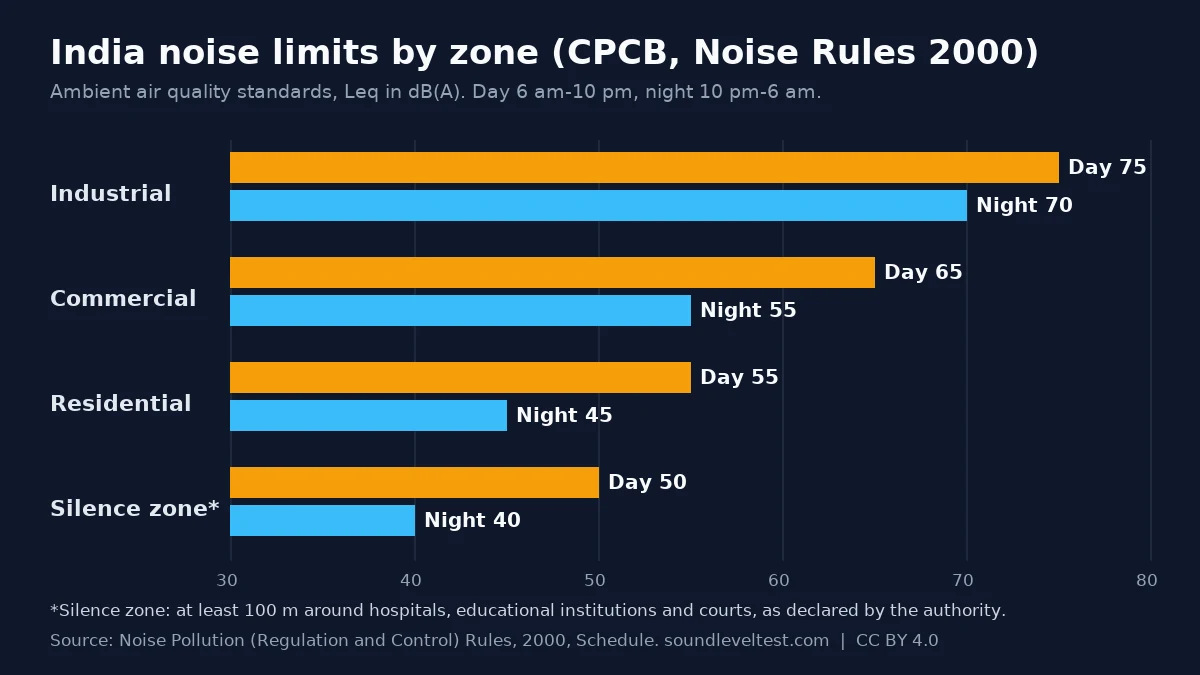
Under the Noise Pollution (Regulation and Control) Rules, 2000, a residential area may average up to 55 dB(A) by day and 45 dB(A) at night. Day is 6 am to 10 pm; night is 10 pm to 6 am. Loudspeakers need permission and are not allowed outdoors at night.
Noise limits by zone
| Zone | Day | Night | Typical places |
|---|---|---|---|
| Industrial area | 75 dB(A) | 70 dB(A) | Factories, industrial estates |
| Commercial area | 65 dB(A) | 55 dB(A) | Markets, shopping streets, offices |
| Residential area | 55 dB(A) | 45 dB(A) | Homes, apartment societies, colonies |
| Silence zone | 50 dB(A) | 40 dB(A) | At least 100 m around hospitals, schools and courts |
Limits are averages over time (Leq), not the loudest moment. A single horn or bark can be louder without the average breaking the limit.
Loudspeakers, festivals and weddings
- Loudspeakers and public address systems need written permission from the local authority.
- They are not allowed between 10 pm and 6 am, except in closed spaces such as auditoriums, community halls and banquet halls.
- A state government can extend the limit to midnight on festival days, for no more than 15 days a year.
- At the edge of a public place, a loudspeaker must stay within 10 dB(A) above the area's limit or 75 dB(A), whichever is lower.
The Supreme Court upheld the night-time ban in In Re: Noise Pollution (2005), describing freedom from excessive noise as part of the right to life.
How to complain about noise
- Talk first, if it's safe. Many problems, like a late party or a generator, end with a polite word or a note to your society or RWA.
- Keep a record. Write down dates, times, how long it lasted and what it was. The noise complaint logger notes timestamps and levels in your browser without recording audio.
- For urgent night noise, call the police on 112. Loudspeaker use after 10 pm is something they can act on directly.
- For ongoing noise, write to the authority named by your state (often the police or district administration) or your State Pollution Control Board. Rule 7 applies when noise is 10 dB(A) or more above the zone limit.
This is general information, not legal advice. Procedures differ between states and cities, so check with your local authority or a lawyer for your situation.
What a phone sound meter can and can't tell you
The sound level test gives a rough, unweighted estimate. It can show that noise at 11 pm is much louder than your room's usual level, which is useful context. It can't prove an exact dB(A) value, because phone microphones aren't calibrated and the rules use A-weighted averages. The dB vs dBA guide explains the difference. For typical levels of everyday sounds, see the decibel chart.
How India's limits compare
The WHO suggests keeping bedroom noise near 30 dB(A) for good sleep, well below the 45 dB(A) outdoor night limit for homes. For hearing safety, the NIOSH limit is 85 dB(A) over eight hours, a much higher level that applies to workplaces. Long-term road noise is covered in how loud is traffic noise.
Frequently asked questions
What is the permissible noise level in a residential area in India?
55 dB(A) during the day (6 am to 10 pm) and 45 dB(A) at night (10 pm to 6 am), measured as an average (Leq) under the Noise Pollution (Regulation and Control) Rules, 2000.
Are loudspeakers allowed after 10 pm in India?
Not without permission. Loudspeakers and public address systems are banned between 10 pm and 6 am, except in closed spaces such as auditoriums and banquet halls. A state government may allow use until midnight during cultural or religious festivals, for up to 15 days a year.
When can I file a complaint under the Noise Rules?
Rule 7 lets a person complain to the designated authority when noise is 10 dB(A) or more above the standard for that zone, or when the night-time restrictions are broken. In urgent cases, such as a loudspeaker at midnight, most people call the local police on 112.
Can my phone's decibel reading be used as evidence?
It can help you show a pattern of dates and times, but it is not a calibrated measurement. Phone microphones vary, and authorities normally rely on calibrated sound level meters. Use your log to support a complaint, not as proof of an exact level.
Is 45 dB(A) at night quiet?
Yes. It is roughly a quiet room with a ceiling fan on low. The WHO recommends even lower levels inside bedrooms, about 30 dB(A), for undisturbed sleep.