Hearing age test
Find the highest pitch you can hear. Headphones on, volume low.
Published:
Use headphones. Set device volume low first.
Screening only — not a medical hearing test. It cannot diagnose hearing loss or tinnitus. Speakers and headphones affect results. If you are worried about your hearing, see an audiologist.
Built by Nayeem, Software Developer of SoundLevelTest.com
Hearing frequency by age
Typical upper limits for healthy ears. People vary widely, so use this as a rough guide.
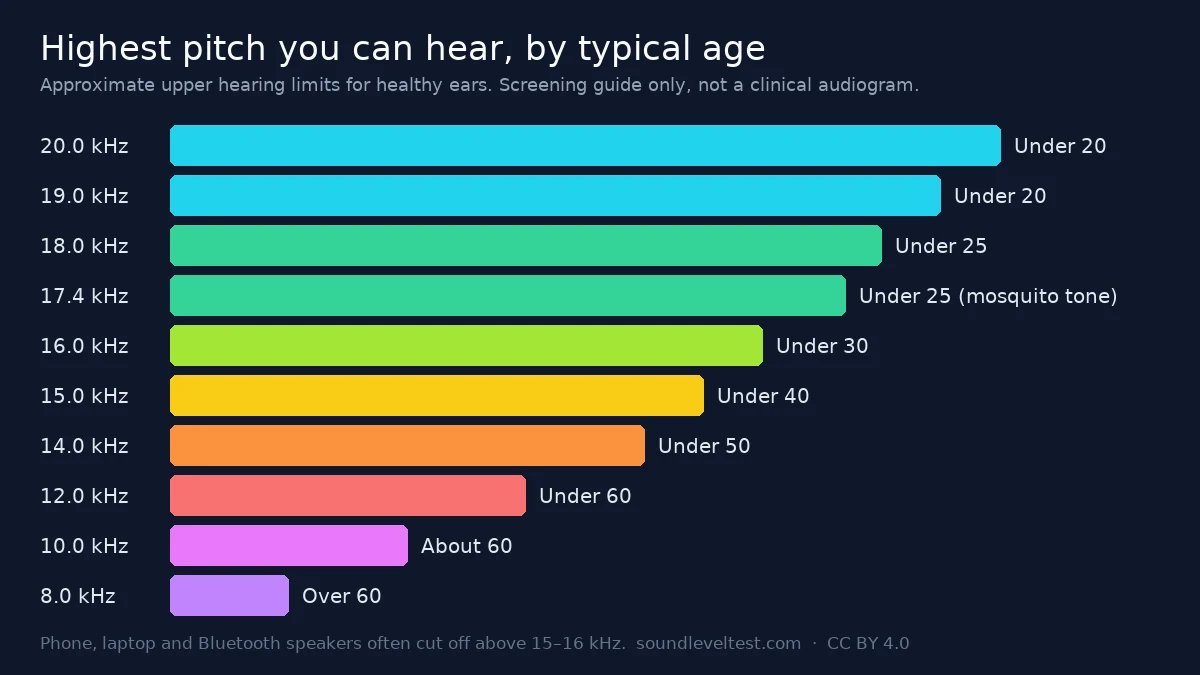
| Frequency | Typical age band | Notes |
|---|---|---|
| 20.0 kHz | Under 20 | Upper limit usually quoted for human hearing |
| 19.0 kHz | Under 20 | |
| 18.0 kHz | Under 25 | |
| 17.4 kHz | Under 25 | The 'mosquito' or teen tone |
| 16.0 kHz | Under 30 | Often the limit for people in their late 20s |
| 15.0 kHz | Under 40 | Old CRT TV whine |
| 14.0 kHz | Under 50 | |
| 12.0 kHz | Under 60 | Commonly still audible in middle age |
| 10.0 kHz | About 60 | |
| 8.0 kHz | Over 60 | Top of a standard clinical hearing test |
Why high-frequency hearing fades
High pitches are picked up by hair cells at the entrance of the cochlea, the first ones every sound passes. They take the most wear over a lifetime, so the top of your range usually drops first. This is called presbycusis. Loud noise speeds it up — see how loud is too loud for safe exposure limits.
Getting a fair result
- Use wired headphones; Bluetooth and phone speakers often cut off above 15–16 kHz.
- Sit in a quiet room and turn off fans or music.
- Check both ears using the left and right options in the tone generator.
- Make sure both channels work first with the speaker test.
Questions people ask
How does the online hearing age test work?
It plays a quiet sine tone, starting at 20 kHz, and steps down through ten frequencies to 8 kHz. You press 'I hear it' as soon as a tone is audible. The highest tone you heard is compared with the upper hearing limits commonly seen at different ages.
Is this a real hearing test?
No. It is a screening tool and a demonstration of how high-frequency hearing fades with age. A clinical hearing test uses calibrated equipment in a quiet booth and checks many frequencies at known levels. If you have trouble hearing, ringing in the ears or a sudden change, see an audiologist or doctor.
Why can't I hear the highest tones?
Two common reasons. The tiny hair cells that detect high pitches wear out first, so most adults lose the top frequencies over time (presbycusis). Also, many phone and laptop speakers cannot play above about 15–16 kHz, so silence may come from the speaker, not your ears. Use decent wired headphones.
What frequency can a 30-year-old hear?
Many people around 30 hear up to roughly 15–16 kHz, but there is wide variation. Noise exposure, genetics and health all matter, so treat the age bands as typical, not as a rule.
Should I turn the volume up if I can't hear a tone?
Only a little. Very high tones can be uncomfortable and loud volume can harm your ears or speakers. If a tone is still silent at a moderate level, move on — that is your answer for this setup.
Is anything recorded?
No. This page only plays sound using your browser. It never uses your microphone and nothing is sent anywhere.