
How to file a noise complaint
A complaint works best with a written record behind it. Here is who to contact, what to write down, and what usually happens next.
Written by Nayeem, Software Developer of SoundLevelTest.com
Published:
Researched and compiled from published guidance by NIOSH, OSHA, CDC, and the WHO.
How do I file a noise complaint?
Check your local noise ordinance and quiet hours, then talk to the source if it is safe. If the noise continues, keep a dated log of each disturbance and report it to your landlord, your city's 311 or code enforcement office, or the police non-emergency line. Keep the reference number for follow-up.
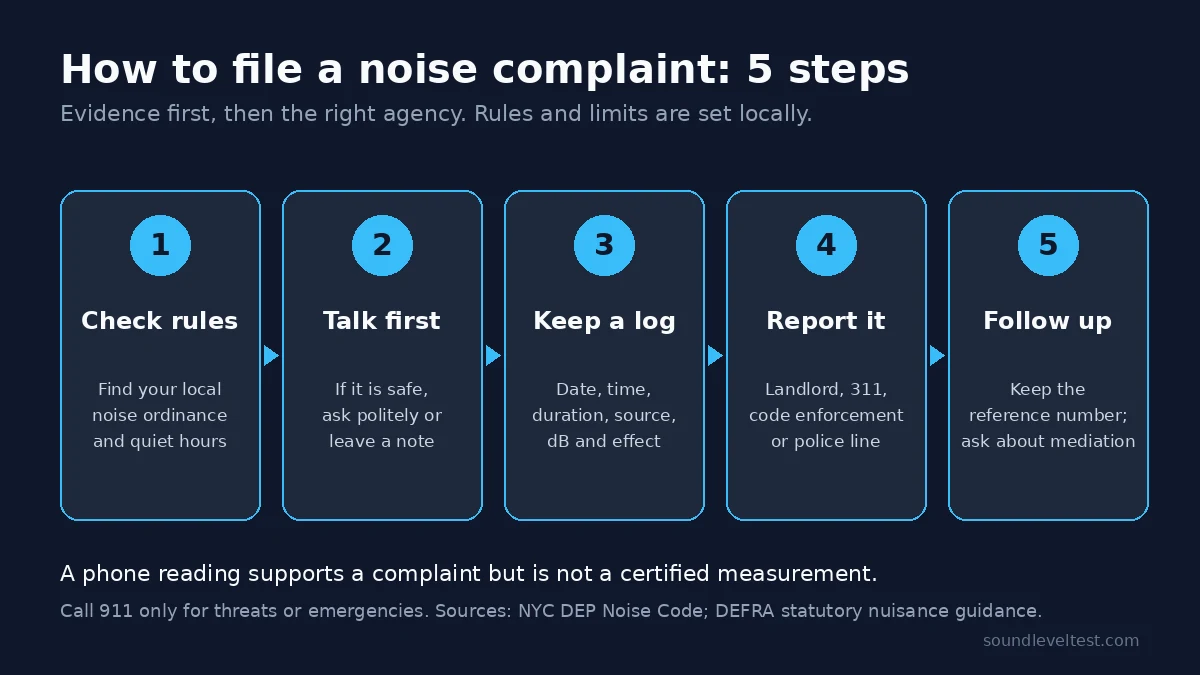
Step-by-step: filing a noise complaint
- Check the local rules. In the US, noise is regulated mainly by states, counties and cities; federal noise programs under the Noise Control Act cover sources such as products and transport, not your neighbour. Search "[your city] noise ordinance" and note the quiet hours and any decibel limits.
- Talk first, if it is safe. A calm conversation or a short note often solves the problem faster than an official report. Skip this step if you feel unsafe.
- Keep a noise log. Write down each event as it happens. A pattern over several days is much stronger than a single complaint. The noise complaint logger can record times and levels for you.
- Report to the right body. Use the table below. Report while the noise is happening when you can, so an officer can hear it.
- Follow up. Keep the reference number, add new log entries, and ask about community mediation if the problem continues. For legal action, get advice from a local lawyer or tenant service.
Who do I call for a noise complaint?
| Situation | Who to contact | Why |
|---|---|---|
| Neighbour in your apartment building | Landlord, property manager or HOA, in writing | Most leases include a quiet enjoyment or nuisance clause. |
| Loud party or music late at night | City 311 or the police non-emergency line | Report while it is happening so it can be checked. |
| Construction outside permitted hours | City building department or code enforcement | Permits usually set allowed working hours. |
| Barking dog that keeps going | Animal control or code enforcement | Many ordinances define how long barking must last. |
| Bar, venue or business | City noise office or licensing authority | Licences can carry noise conditions. |
| Threats, fighting or danger | 911 (emergency) | Noise alone is not an emergency. |
Example: in New York City, complaints go through 311 by phone or online, and the NYC Department of Environmental Protection and NYPD share enforcement of the city Noise Code. Other cities route complaints differently, so check your city's website.
What to write in your noise log
- Date, start time and end time of each event
- What the noise was (music, bass, barking, shouting, machinery) and where it came from
- Where you heard it, for example your bedroom with the windows closed
- An approximate decibel reading and the peak level, if you measured
- How it affected you: woke you up, stopped you working, kept a child awake
- Any contact you made with the source and their response
What decibel level is a noise violation?
There is no single number. Local ordinances set limits, often lower at night and measured at the property line or inside the affected home, and many also ban noise that is "plainly audible" or unreasonable without any decibel figure. For context, the WHO Guidelines for Community Noise suggest bedrooms stay near 30 dB LAeq at night. Compare your readings with the decibel chart or read how many decibels is too loud for neighbours.
Does a phone decibel reading count as evidence?
It helps, but it is not proof on its own. Phone microphones vary and are not certified, so officials rely on calibrated sound level meters. Your readings are most useful for showing a pattern: the same loud events at the same hours, night after night. See our measurement methodology for the limits of browser readings.
Filing a noise complaint outside the US
In England, councils must look into complaints about noise that could be a statutory nuisance under the Environmental Protection Act 1990, and can serve an abatement notice that requires the noise to stop or be reduced (DEFRA guidance). In India, see noise pollution rules in India for zone limits and complaint steps.
Frequently asked questions
How do I file a noise complaint?
Find your local noise ordinance and quiet hours, talk to the source first if it is safe, keep a dated log of each disturbance, then report it to the right body: your landlord for a building neighbour, or your city's 311, code enforcement or police non-emergency line. Keep the reference number.
Who do I call for a noise complaint?
In most US cities, use 311 or the police non-emergency number, not 911. In New York City, noise complaints go through 311 and are enforced by the Department of Environmental Protection and the NYPD. In England, contact your local council.
What decibel level is a noise violation?
There is no single national number. US noise limits are set by states, counties and cities, often with lower limits at night and measured at the property line. Many ordinances also ban plainly audible or unreasonable noise without a decibel figure.
Can I use a phone decibel reading as evidence?
A phone reading helps show a pattern of times and approximate levels, but it is not a certified measurement. Enforcement officers use calibrated sound level meters. Treat your readings as supporting notes alongside a written log.
Can I file a noise complaint anonymously?
It depends on the city. Some 311 systems accept reports without contact details, while others need them for follow-up. Ask the agency how your details are handled before you report.
General information, not legal advice. Rules change; check your local ordinance or agency before acting.