
Human hearing frequency range
What pitches people can hear, where ears are most sensitive, and how the range shrinks with age.
Published:
Play a short tone from each part of the range
Start with your volume low. Each tone lasts 1.5 seconds. Phone and laptop speakers often cannot play 60 Hz or 16 kHz, so use headphones.
Written by Nayeem, Software Developer of SoundLevelTest.com
Latest update: First published with frequency band, age limit and animal comparison tables, short tone previews and an original hearing range chart.
What is the human hearing range?
Healthy young ears hear sound from about 20 Hz to 20,000 Hz. Hearing is most sensitive between 2 and 5 kHz, where speech consonants sit. The upper limit falls with age and noise exposure, so many adults stop hearing above 15 to 17 kHz. Sounds below 20 Hz are infrasound; above 20 kHz, ultrasound.
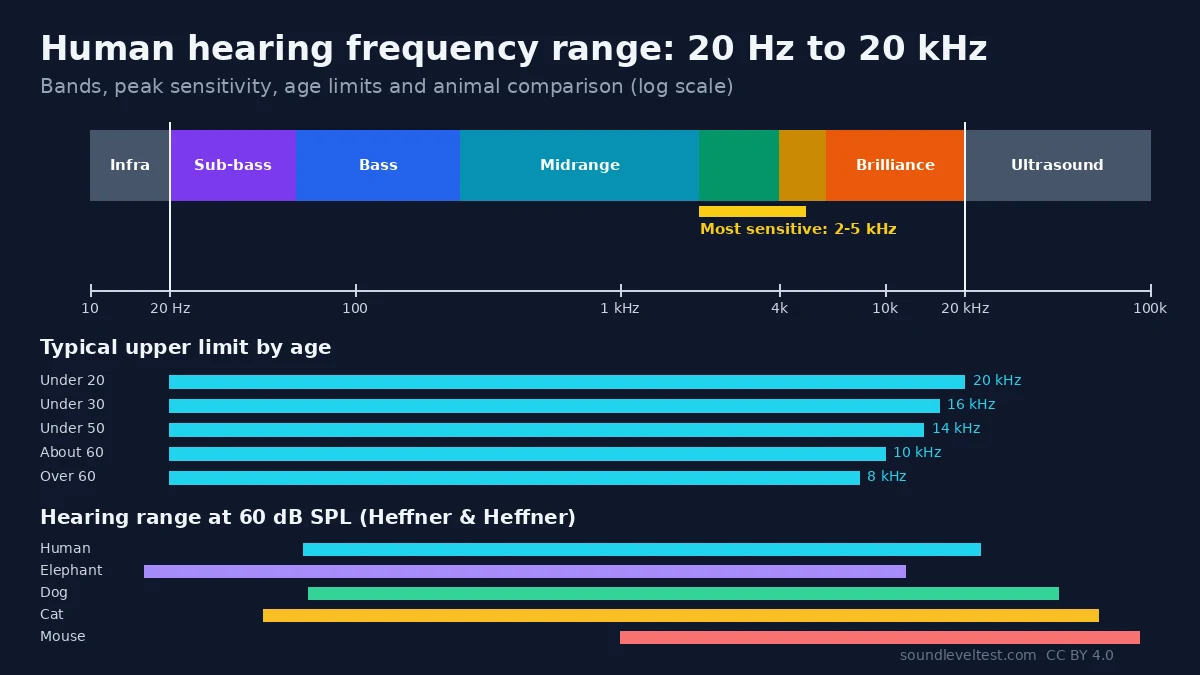
Frequency bands of human hearing
| Band | Range | What you hear |
|---|---|---|
| Infrasound | Below 20 Hz | Below hearing; felt as vibration at high levels |
| Sub-bass | 20 Hz to 60 Hz | Rumble, kick drum weight, pipe organ pedals |
| Bass | 60 Hz to 250 Hz | Male voice fundamentals, bass guitar |
| Midrange | 250 Hz to 2 kHz | Vowels and most instrument fundamentals |
| Upper midrange | 2 kHz to 4 kHz | Consonants and speech clarity; ears are most sensitive here |
| Presence | 4 kHz to 6 kHz | Edge and detail of voices and instruments |
| Brilliance | 6 kHz to 20 kHz | Cymbals, sibilance, air; first range lost with age |
| Ultrasound | Above 20 kHz | Above human hearing; used by bats, dogs and medical imaging |
Hearing range by age
High frequencies go first. These are rough bands for the highest tone most people in each group still hear; individual results vary widely. Try them yourself with the hearing age test.
| Highest tone heard | Typical age group |
|---|---|
| 20 kHz | Under 20 |
| 18 kHz | Under 25 |
| 16 kHz | Under 30 |
| 15 kHz | Under 40 |
| 14 kHz | Under 50 |
| 12 kHz | Under 60 |
| 10 kHz | About 60 |
| 8 kHz | Over 60 |
Human vs animal hearing range
| Species | Range at 60 dB SPL |
|---|---|
| Human | 64 Hz to 23 kHz |
| Elephant | 16 Hz to 12 kHz |
| Dog | 67 Hz to 45 kHz |
| Cat | 45 Hz to 64 kHz |
| Mouse | 1 kHz to 91 kHz |
Source: Heffner, H. E. & Heffner, R. S. (2007), Hearing ranges of laboratory animals, Journal of the American Association for Laboratory Animal Science; elephant: Heffner & Heffner (1982). Measured at 60 dB SPL, so the human figure differs from the everyday 20 Hz to 20 kHz rule.
Explore frequencies with your own ears and mic
Play any pitch from 20 Hz to 20 kHz with the online tone generator, find the pitch of a voice or whistle with the microphone frequency detector, and learn why sound meters weight low and high tones differently in dB vs dBA. Loud sound at any frequency can damage hearing, so check levels on the decibel chart.
This page is general information, not a medical test. If you notice ringing, muffled hearing or trouble following speech, see an audiologist.
Questions people ask
What is the human hearing frequency range?
Young, healthy ears hear roughly 20 Hz to 20,000 Hz (20 kHz). The exact limits vary from person to person and depend on how loud the sound is; very low and very high tones need much more level to be heard.
Which frequencies are humans most sensitive to?
About 2,000 to 5,000 Hz. The ear canal resonates near 3 to 4 kHz, which boosts this region. It is also where consonants such as s, t and f carry speech clarity.
Why do adults lose high frequencies?
Age-related hearing loss (presbycusis) and noise exposure damage hair cells at the base of the cochlea first, and those cells respond to high frequencies. Many adults over 30 no longer hear 17 to 18 kHz.
Can humans hear below 20 Hz?
Not as a tone. Infrasound below 20 Hz can be felt as pressure or vibration at high levels, but it is not heard as pitch.
What frequency range is human speech?
Voice fundamentals sit around 85 to 255 Hz, while the information that makes speech understandable lies mostly between 500 Hz and 4 kHz. Telephone audio keeps only about 300 Hz to 3.4 kHz and is still intelligible.
How can I test my own hearing range?
Use headphones at a low volume and try the hearing age test, which steps down from 20 kHz. It is a rough screen only; a clinical audiogram by an audiologist is the reliable test.
Do dogs and cats hear higher than humans?
Yes. At 60 dB SPL dogs hear up to about 45 kHz and cats up to about 64 kHz, while humans reach about 23 kHz at that level. Elephants hear lower than humans, down to about 16 Hz.