Classroom noise level standards
The dB limits schools are built to, and practical targets for a busy lesson.
Published:
Check your own room now
Set an activity limit and get a silent green, amber or red alert. Runs in the browser; no audio is uploaded.
Open the classroom noise monitorWritten by Nayeem, Software Developer of SoundLevelTest.com · Latest update: First published with a comparison of ANSI S12.60, WHO and BB93 classroom limits, occupied-room data, activity targets and an original standards chart.
What is the standard noise level for a classroom?
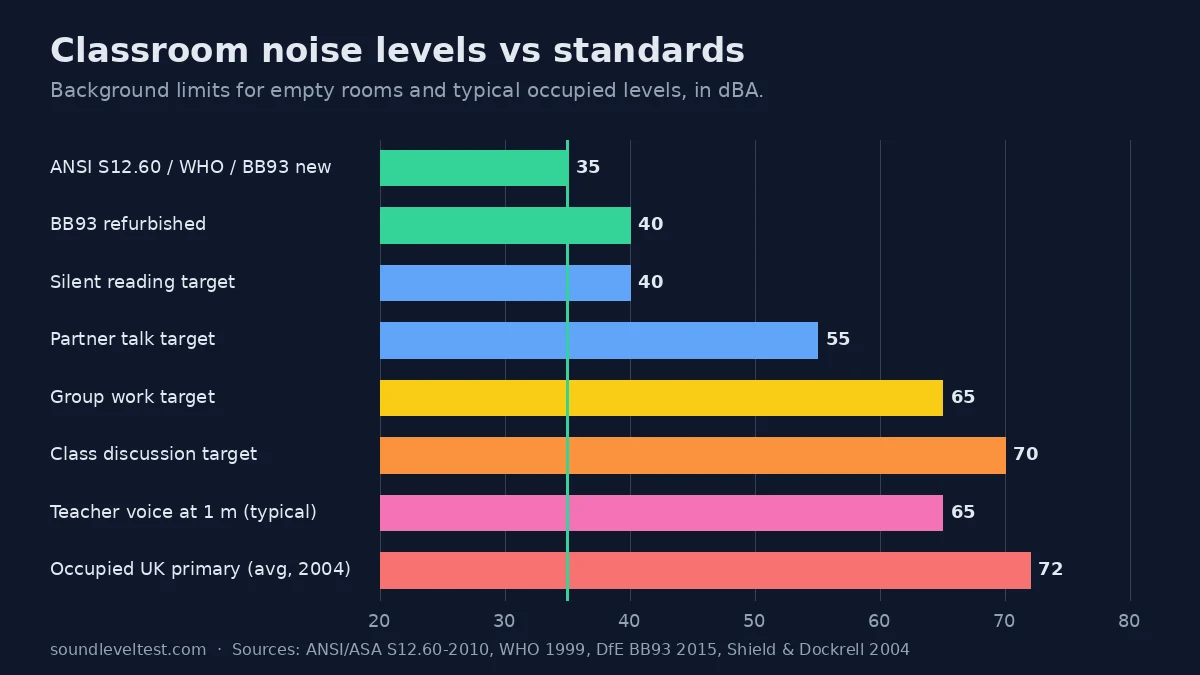
An empty classroom should have background noise no higher than 35 dBA, the limit set by ANSI/ASA S12.60, the WHO and UK BB93 for new schools. Echo should fade within about 0.6 seconds. During lessons, the teacher's voice should stay at least 15 dB above the background.
Classroom acoustics standards compared
| Standard | Background noise | Reverberation time |
|---|---|---|
| ANSI/ASA S12.60-2010 Part 1 (US) | 35 dBA, 1-hour average, empty room | 0.6 s (rooms up to 283 m³); 0.7 s (283 to 566 m³) |
| WHO Guidelines for Community Noise (1999) | 35 dB LAeq during lessons | 0.6 s |
| UK Building Bulletin 93 (2015), new build | 35 dB LAeq,30min (general teaching) | 0.8 s or less (secondary); 0.6 s (primary) |
| UK Building Bulletin 93 (2015), refurbished | 40 dB LAeq,30min | 1.0 s or less |
Check the current edition of each document before using it for design or compliance work.
How loud classrooms really get
Standards describe the empty room. Once students arrive, levels rise sharply: Shield and Dockrell (2004) measured an average of about 72 dB LAeq in occupied London primary classrooms, and a teacher speaking normally produces roughly 60 to 65 dB at 1 metre. That gap is why the 15 dB speech margin recommended by ASHA is hard to hold during group work, and why teachers often strain their voices.
Practical dB targets by activity
| Activity | Working target |
|---|---|
| Silent reading or tests | Under 40 dB |
| Partner talk | 40 to 55 dB |
| Group work | 55 to 65 dB |
| Class discussion | 60 to 70 dB |
These match the presets in the classroom noise monitor and its voice levels 0 to 4 guide. For context on other everyday sounds, see the decibel chart and how many decibels is too loud. Why meters read in dBA is explained in dB vs dBA.
Ways to lower classroom noise
- Add soft surfaces: acoustic ceiling tiles, wall panels, rugs and felt pads on chair legs cut echo and scraping.
- Close windows and doors facing traffic or corridors during quiet work.
- Agree a voice level for each activity and show it visually, so students can self-correct.
- Seat children who struggle to hear close to where the teacher usually speaks.
Questions people ask
What is the recommended noise level in a classroom?
Background noise in an empty classroom should not exceed 35 dBA under ANSI/ASA S12.60-2010 in the US, the WHO 1999 guidelines and UK Building Bulletin 93 for new schools. That limit covers ventilation, lights and outside noise, not students.
How loud is a typical occupied classroom?
Much louder than the empty-room limit. Shield and Dockrell (2004) measured occupied London primary classrooms at an average of about 72 dB LAeq. Group activities commonly reach 65 to 75 dB.
What reverberation time should a classroom have?
ANSI S12.60 sets 0.6 seconds for core learning spaces up to 283 m³ and 0.7 seconds for 283 to 566 m³. Long echo blurs speech even when the room is quiet.
What is a good signal-to-noise ratio for teaching?
The American Speech-Language-Hearing Association recommends the teacher's voice be at least +15 dB above background noise at the student's ear. Young children, second-language learners and children with hearing loss need this margin most.
Is ANSI S12.60 mandatory?
It is a voluntary standard unless a state, district or building code adopts it. In England, BB93 limits apply to new and refurbished school buildings through building regulations.
Can a phone measure classroom compliance?
No. Compliance needs a calibrated Class 1 or 2 sound level meter and a defined procedure. A browser or phone meter is useful for spotting trends and setting activity limits, which is how the classroom noise monitor is meant to be used.